Written & Reviewed by


Last updated: May 4, 2026
Bottom line: Many Florida seniors miss SNAP because they rely on old income charts or never turn in proof of medical costs. Florida says most SNAP households must have 200% gross income of the federal poverty level. Adults age 60 or older can often get more help in the budget because SNAP has senior rules for medical and shelter costs.
If you get Social Security retirement, Supplemental Security Income (SSI), a pension, or VA income, do not assume you are over-income. Florida can count medical costs over $35 a month when they are not paid back by insurance or another source. Your best path may be regular SNAP or SUNCAP, depending on your SSI status, housing costs, and medical costs.
For more help in the same state, see our Florida senior benefits guide. If you want a broader overview, start with food programs for seniors, our national SNAP for seniors guide, or use our senior help tools to pick a next step.
Emergency help now
- Apply today through MyACCESS, or call the Florida Department of Children and Families (DCF) at 850-300-4323 if you cannot get online.
- Ask about expedited SNAP if you have almost no food or money. DCF says a regular food assistance application may take up to 30 days, but crisis cases may be screened faster through the application process.
- Call the Florida Elder Helpline at 1-800-963-5337 if you need meals, pantry help, or home-delivered food while your SNAP case is pending.
- If your EBT card is lost, stolen, or damaged, call EBT Customer Service at 1-888-356-3281 immediately to protect the card and change your personal identification number (PIN).
Where to start
| Your situation | Best first step | What to ask |
|---|---|---|
| You need food help now | Apply online and call the Elder Helpline | Ask about expedited SNAP and local meals. |
| You get SSI and live alone | Ask DCF about SUNCAP | Ask if SUNCAP or regular SNAP would pay more. |
| You have medical bills | Apply for regular SNAP | Ask DCF to count all medical costs over $35. |
| You do not use a computer | Use a DCF office, community partner, or paper form | Ask where to upload, mail, fax, or hand-deliver proof. |
| Your benefit seems too low | Call DCF for a budget review | Ask if medical and shelter deductions were counted. |
Quick help:
- Fastest path: Use the MyACCESS portal. DCF says online filing is the quickest way to apply and manage benefits.
- On SSI and living alone? Ask whether SUNCAP is easier than regular SNAP.
- High medical bills? Regular SNAP may pay more because seniors can claim allowed medical deductions.
- No computer? Use a DCF application option, or ask your local Aging and Disability Resource Center where to get hands-on help.
- Need food this week? Ask the Elder Affairs food network about meals, senior food boxes, and produce programs near you.
What SNAP for seniors over 60 in Florida actually looks like
Start here: Use current Florida rules, not old blog posts. Many seniors still see old 130% income charts online. Florida’s current SNAP eligibility page says most households must have gross income at or below 200% of the federal poverty level. Then DCF subtracts allowed deductions, including medical costs, to decide whether you qualify and how much you may get.
For many older adults, the biggest missed item is medical paperwork. Medicare Part B and Part D premiums, Medigap or other insurance premiums, prescription costs, co-pays, hearing aids, dental care, glasses, transportation to medical care, and some approved over-the-counter items can matter under Florida SNAP policy. If you do not turn those costs in when DCF asks, your benefit can be much lower.
Florida also has a simpler path for some seniors on SSI. DCF says SUNCAP may let certain SSI recipients get food assistance without a separate application, paperwork, or interview. But simpler does not always mean better. If you have high housing or medical costs, regular SNAP can still be the better choice.
The income chart is tied to the federal poverty level. That number changes each year, so old screenshots and old Facebook posts can be wrong.
Quick facts
- Best immediate takeaway: Apply even if your income is above the old 130% SNAP figure. Florida’s current chart includes a 200% gross-income limit for most households.
- One major rule: Seniors can get credit for unreimbursed medical expenses above $35 per month.
- One realistic obstacle: If you do not verify medical expenses when DCF asks, the deduction may not be counted in the first budget.
- One useful fact: The current DCF SUNCAP brochure says Florida serves over 44,000 SUNCAP households statewide.
- Best next step: Gather proof of income, rent or mortgage, utilities, and every medical bill you pay out of pocket. Then apply online, by paper, or with local help.
Who qualifies
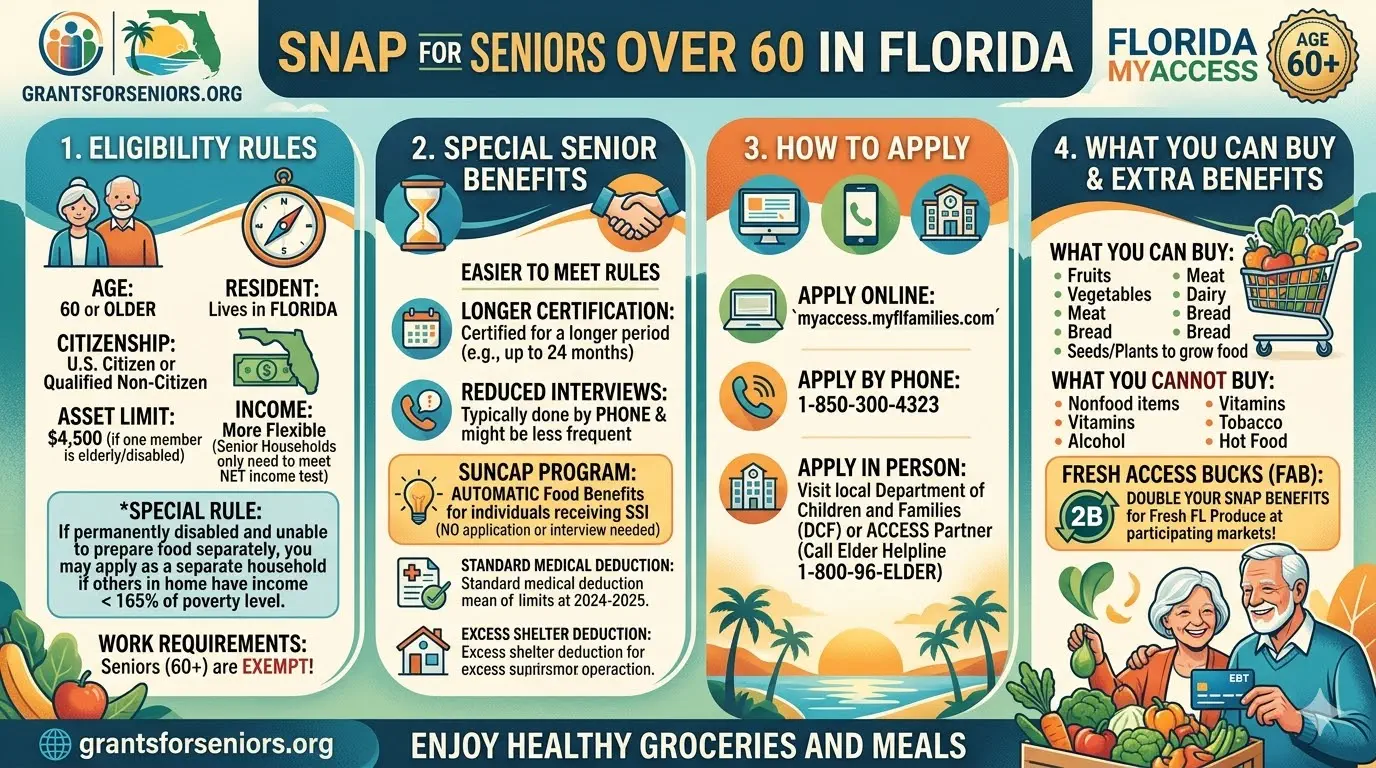
Under federal SNAP rules, you are considered elderly at age 60 or older. In Florida, that matters because older adults can use senior medical deductions and may have fewer work-rule problems than younger applicants.
In simple terms, most Florida seniors qualify when they:
- live in Florida and apply through DCF;
- are a U.S. citizen or qualified noncitizen;
- provide a Social Security number or proof they applied for one;
- meet the income rules after DCF counts deductions; and
- turn in proof DCF asks for.
Important: Florida says most SNAP households can still have vehicles, bank accounts, or other property and get help. The asset limit usually matters only if your household has a disqualified member. In those cases, the current asset limit is $4,500 if the household includes an elderly or disabled member.
Also important: If you live with other people, SNAP household rules matter. Spouses who live together are usually one household. If you live with an adult child or roommate and buy and prepare food separately, you may be able to apply separately. If you are 60 or older, permanently disabled, and unable to buy and prepare meals separately, a special separate-household rule may still help if the people you live with are below the income limit.
These are the current senior-relevant Florida SNAP numbers to use for May 2026 cases. The income figures come from the Florida DCF Appendix A-1, and the USDA FY 2026 table lists the maximum benefits.
| Household size | Florida 200% gross monthly income limit | Florida net monthly income limit | Maximum monthly SNAP benefit |
|---|---|---|---|
| 1 | $2,610 | $1,305 | $298 |
| 2 | $3,526 | $1,763 | $546 |
| 3 | $4,442 | $2,221 | $785 |
| 4 | $5,360 | $2,680 | $994 |
Note: For one- and two-person households, the current minimum monthly benefit is $24. Your actual amount can be lower than the maximum because SNAP is based on countable income after deductions.
Best assistance programs for seniors
Regular Florida SNAP
- What it is: The main Supplemental Nutrition Assistance Program, run by DCF, that loads monthly food benefits onto an EBT card.
- Who can get it: Florida seniors who meet current income, citizenship, identity, and residency rules. This is often the best fit for seniors with high medical or housing costs.
- How it helps: It pays for eligible groceries. Current maximum benefits are $298 for one person and $546 for two people, with a $24 minimum for one- and two-person households.
- How to apply: Use MyACCESS, visit a Family Resource Center or community partner, or file a paper application.
- What to gather: ID, Social Security number, proof of income, rent or mortgage, utilities, and every out-of-pocket medical expense you pay.
SUNCAP for SSI recipients
- What it is: A special Florida food assistance program for some people who receive Supplemental Security Income (SSI).
- Who can get it: The current DCF SUNCAP brochure says you may qualify if you receive SSI, are at least 18, are not working, and buy and prepare food alone.
- How it helps: Some people can get SUNCAP without a separate SNAP application, interview, or extra paperwork.
- How to apply: Apply for SSI, apply for regular SNAP and ask about conversion, or call DCF at 850-300-4323 about the SUNCAP path.
- What to gather: SSI information, ID, address, and any regular SNAP case information you already have.
Reality check: The DCF SUNCAP brochure says regular SNAP may be better if you pay more than $35 a month in out-of-pocket medical expenses or more than $800 a month in rent, mortgage, or property taxes. Because that brochure is dated 2021, ask DCF to compare your current regular SNAP amount against SUNCAP before you switch.
Home-delivered and congregate meals for seniors
- What it is: Local senior meal programs coordinated through the Florida Department of Elder Affairs food assistance network.
- Who can get it: Florida says food assistance programs for people age 60 and older are available in all 67 counties, although waiting lists and local rules can vary.
- How it helps: These meals can cover the gap while you wait for SNAP, especially if you are homebound, recovering from illness, or cannot shop safely.
- How to apply: Call the Elder Helpline at 1-800-963-5337 or use the ADRC directory.
- What to gather: Age, address, phone number, and a simple explanation of whether you are homebound or need meal-site help.
Senior Farmers’ Market Nutrition Program
- What it is: A seasonal produce program that gives eligible seniors a $40 bundle of fresh, locally grown fruits and vegetables.
- Who can get it: Seniors age 60 or older with income at or below 185% of federal poverty guidelines who live in participating counties.
- How it helps: Distributions are first-come, first-served, usually beginning in early April and running through November 30 or until funds run out.
- How to apply: Use the official county list or call the Elder Helpline.
- What to gather: Proof of age, address, and income if the local lead agency asks for it.
Commodity Supplemental Food Program
- What it is: A senior food box program that supplements the diets of low-income seniors with USDA Foods.
- Who can get it: Florida says the program is for low-income seniors age 60 and older, but local availability can vary.
- How it helps: It can stretch a small SNAP benefit or help while your application is delayed.
- How to apply: Start with the Elder Affairs food network or call the Elder Helpline and ask about CSFP senior food boxes in your county.
- What to gather: ID, proof of age, address, and income documents.
Fresh Access Bucks
- What it is: A statewide produce incentive program run by Feeding Florida.
- Who can get it: SNAP shoppers using their benefits at participating Florida farmers markets, produce stands, mobile markets, and some community groceries.
- How it helps: It can make fresh, Florida-grown produce more affordable and can help seniors stretch benefits farther.
- How to apply: Use the Fresh Access Bucks site or ask your local market whether it participates.
- What to gather: Your EBT card and any site-specific instructions from the market or store.
How to apply without wasting time
- Gather medical bills first. This saves the most money for many seniors. Pull together Medicare premiums, drug costs, co-pays, dental bills, hearing aid costs, glasses, rides to doctors, and any other out-of-pocket medical costs.
- Choose the right track. If you get SSI and buy and prepare food alone, ask whether SUNCAP is better than regular SNAP.
- Apply the fastest way. DCF says online filing is the quickest option and that the portal is available 24 hours a day.
- Use in-person help if needed. You can also apply at a Family Resource Center or community partner. Public libraries may also help you get online.
- Send proof right away. DCF says to write your ACCESS or case number, name, date of birth, and phone number on every document you submit.
- Keep paper options in mind. The paper application can be mailed to the Office of Economic Self Sufficiency Mail Center, P.O. Box 1770, Ocala, FL 34478-1770 or faxed to 1-866-886-4342.
- Watch both mail and MyACCESS. DCF says it may still take up to 30 days to finish a food assistance application, so respond quickly to any request for verification.
Application checklist
- ☐ Photo ID
- ☐ Social Security number or proof you applied for one
- ☐ Proof of Florida address
- ☐ Social Security, pension, SSI, wages, or other income proof
- ☐ Rent, mortgage, property tax, homeowners insurance, or lot rent proof
- ☐ Electric, gas, water, phone, and other utility bills
- ☐ Medicare, insurance, prescription, co-pay, dental, vision, hearing, and transportation medical costs
- ☐ Any DCF notice asking for specific verification
- ☐ A folder or envelope for copies of everything you send
Reality checks
| Issue | What it means | What to do |
|---|---|---|
| Medical deductions | They are not automatic. | Send proof and ask DCF to count them. |
| SUNCAP | It is simpler, but not always higher. | Ask DCF to compare both budgets. |
| Healthy SNAP rules | Some foods are now blocked at checkout. | Read store signs and check MyACCESS notices. |
| Stolen benefits | Replacement rules are now very limited. | Change your PIN and report theft fast. |
- Medical deductions are not automatic. If you report medical expenses but do not verify them, DCF can approve your case without the deduction. If you send proof later, you may not get the increase back to the first certification month.
- SUNCAP is easier, but not always better. The current brochure says regular SNAP may be better for people with higher medical or housing costs.
- Florida changed what SNAP can buy. The official Florida Healthy SNAP page says that since April 20, 2026, soda, energy drinks, candy, and ultra-processed shelf-stable prepared desserts are no longer eligible for purchase with SNAP benefits in Florida.
- Stolen benefit reimbursement is now very limited. Florida says the USDA-funded replacement program for stolen SNAP benefits ended December 20, 2024. That makes fast PIN changes and card protection more important.
Common mistakes to avoid
- Using old income charts. Florida’s current eligibility page uses a 200% gross-income test for most households, not the old 130% rule many sites still show.
- Leaving medical costs off the form. Seniors often forget Medicare premiums, prescription costs, hearing aids, dental care, glasses, and rides to doctors.
- Assuming SUNCAP is always best. It can be simpler, but regular SNAP can pay more if your deductions are high.
- Ignoring a work notice if you are 60 to 64. USDA guidance says people age 60 or older remain exempt from the general work requirements, including mandatory SNAP Employment and Training. Florida also has ABAWD rules for some adults through age 64. If you get a confusing notice, call DCF and ask for a review.
- Paying someone to apply. DCF says applying for government assistance benefits is free.
Best options by need
- I live alone on Social Security and groceries are getting too expensive: Apply for regular SNAP and turn in every medical expense.
- I get SSI and want the simplest route: Compare SUNCAP with regular SNAP before you decide.
- I am homebound or cannot shop safely: Call the Elder Helpline about home-delivered meals while your SNAP case moves.
- I need fresh produce, not just shelf-stable food: Check Fresh Access Bucks and the Senior Farmers’ Market Nutrition Program.
- I do not use computers: Apply through a DCF office, community partner, or paper application.
- My benefit seems too low: Ask DCF whether your medical and shelter deductions were budgeted correctly.
If food costs are part of a larger budget problem, our utility bill help guide and housing help in Florida page can help you look for other relief.
If your application gets denied
- Read the denial notice line by line. Look for the exact reason: income, missing proof, household size, citizenship, or something else.
- Call DCF at 850-300-4323. Ask these questions: What proof is missing? Were my medical expenses counted? What household size did you use? What date is my deadline to fix this?
- Send missing proof fast. If DCF denied you because something was missing, upload it in MyACCESS or use the paper route.
- Request a fair hearing if the decision looks wrong. Florida lets you request a hearing online, by mail, email, or phone. The hearing office phone number is 850-488-1429.
- Get legal help. The Florida Senior Legal Helpline offers free advice at 1-888-895-7873 if benefits are denied, delayed, or stopped.
If SNAP is delayed or the amount is too low
- Ask for a case review. A missing medical deduction is one of the most common reasons a senior benefit is too small.
- Use local senior meal help now. Start with the Department of Elder Affairs food assistance network or the Elder Helpline.
- Check for senior food boxes. Ask your ADRC whether Commodity Supplemental Food Program boxes are available in your county.
- Use seasonal produce help. The Senior Farmers’ Market Nutrition Program and Fresh Access Bucks can make food dollars go farther.
- After a hurricane or other disaster, check for temporary SNAP changes. Florida sometimes gets county-specific waivers or replacement rules after storms, so check DCF updates and ask whether special disaster food help is active.
When food runs short, local help may be faster than a benefits decision. Our charities helping seniors guide can also give you backup places to call.
Local resources
- DCF Customer Call Center: 850-300-4323, Florida Relay 711, TTY 1-800-955-8771, Monday through Friday, 8:00 a.m. to 5:00 p.m.
- Find a local office or partner: Start on the Florida Public Assistance page for Family Resource Centers and partner help.
- Elder Helpline and ADRCs: Call 1-800-963-5337 or use the ADRC directory. Florida’s ADRCs are the main local gateway for meals, caregiver support, and senior service referrals.
- Local variation matters: The official ADRC directory shows different agencies by region, including agencies serving Broward County, Palm Beach and the Treasure Coast, and Miami-Dade.
- Free legal help for seniors: The Florida Senior Legal Helpline is 1-888-895-7873.
- Extra local food help: Ask 211, your county human services office, your local senior center, or your public library where seniors can get pantry boxes or application help.
For a broader map of aging services, our Florida aging agencies guide can help you find the right local office.
Diverse communities
- Seniors with disabilities: Florida SNAP rules let older adults count many unreimbursed medical expenses, and the ADRC system can screen for home-delivered meals and other supports. DCF also says free language assistance and other aids and services are available on request.
- Immigrant and refugee seniors: SNAP is limited to U.S. citizens and qualified noncitizens. If your status is complicated, get legal advice before you apply. DCF says it offers free language help if English is a barrier.
- Rural seniors with limited access: Use the paper application, fax, or mail options if internet service is unreliable. The Elder Helpline can also point you to the closest local provider.
Other options
- Online grocery ordering: Florida allows SNAP online at approved retailers, but delivery fees cannot be paid with SNAP.
- Paid backup help: If you can afford a small extra cost, a family member or store delivery service may help with shopping while you use SNAP for the food and a separate payment method for fees or tips.
- Local food pantries: Some counties have senior pantry boxes, mobile food drops, or church-based food closets. Ask the Elder Helpline, 211, or your county human services office.
Phone scripts you can use
Call DCF about applying
“Hello, I am over 60 and I want to apply for SNAP. I do not use a computer well. Can you tell me the best way to apply, where I can get in-person help, and what proof I should send first?”
Call DCF about medical costs
“Hello, I already applied for SNAP or I already have SNAP. I pay medical costs every month. Can you check whether my Medicare premiums, prescriptions, co-pays, dental, vision, hearing, and transportation costs were counted?”
Call about SUNCAP
“Hello, I receive SSI and I buy and prepare my food alone. Can you check whether SUNCAP applies to me? Before any change, can you compare SUNCAP with regular SNAP to see which budget is better?”
Call the Elder Helpline
“Hello, I am a Florida senior and I need food help while my SNAP case is pending. Can you screen me for home-delivered meals, congregate meals, senior food boxes, produce programs, or pantry help in my county?”
Resumen en español
Si usted tiene 60 años o más, no descarte SNAP solo porque vio una tabla vieja en internet. Florida usa para la mayoría de los hogares un límite bruto de hasta 200% del nivel federal de pobreza. Además, las personas mayores pueden recibir crédito por gastos médicos no reembolsados de más de $35 al mes. La forma más rápida de solicitar es por MyACCESS, pero también puede pedir ayuda en una oficina de DCF o con un socio comunitario.
Si usted recibe SSI y compra y prepara comida por su cuenta, pregunte si SUNCAP le conviene más que SNAP regular. Si tiene gastos médicos altos, SNAP regular puede ser mejor. Pida a DCF que compare las dos opciones antes de cambiar.
Si necesita comida mientras espera, llame a la Elder Helpline al 1-800-963-5337 para pedir comidas, cajas de alimentos u otra ayuda local. También puede usar nuestra guía de comidas para mayores en Florida para buscar opciones locales. Si DCF niega su caso, usted puede pedir una audiencia y también llamar a la línea legal para adultos mayores al 1-888-895-7873.
FAQ
Can I get Florida SNAP if I receive Social Security retirement, SSI, or a pension?
Yes. Income still counts in the SNAP budget, but receiving Social Security, SSI, a pension, or VA income does not automatically disqualify you. If you get SSI and meet the other rules, SUNCAP may be available. If your main income is Social Security retirement, regular SNAP may still work well, especially when DCF counts medical and shelter deductions.
Do Florida seniors over 60 have work requirements?
For most seniors, this should not be the main issue. USDA says people age 60 or older are elderly for SNAP purposes and remain exempt from the general work rules, including mandatory SNAP Employment and Training. Florida notices can still be confusing because ABAWD time-limit rules changed in 2025. If you are 60 to 64 and get a work notice, call 850-300-4323 and ask DCF to review it.
What medical expenses count for Florida seniors?
Florida seniors can get credit for many costs when they are not reimbursed by insurance or someone else. That can include Medicare premiums, other health insurance premiums, prescriptions, doctor and hospital co-pays, dental work, eye exams, glasses, hearing aids, transportation to medical care, service animal costs, and some approved over-the-counter items. The most important step is to save proof and turn it in.
Is SUNCAP better than regular SNAP?
Not always. SUNCAP is simpler, which is why it helps many SSI recipients. But the DCF brochure says regular SNAP may be better for people with higher medical costs or housing costs. If you are helping a parent on SSI, ask DCF to compare both options before any switch. That can prevent a lower monthly benefit.
Can I get SNAP if I live with my adult child or a roommate in Florida?
Sometimes, yes. If you buy and prepare food separately, you may be able to have your own SNAP household. Spouses who live together are usually one household. And if you are 60 or older and permanently disabled and cannot buy and prepare meals separately, a special separate-household rule may apply if the people you live with are under the income limit.
Can I use Florida SNAP online or outside Florida?
Yes. DCF says food assistance can be used in all 50 states. Florida also allows online SNAP purchasing at approved retailers, but you still cannot use SNAP for delivery fees, tips, or other nonfood charges. If you travel, your card should still work at authorized SNAP retailers.
What should I do if my EBT benefits were stolen or skimmed?
Call EBT Customer Service at 1-888-356-3281 right away, replace the card if needed, and change the PIN. Federal replacement authority ended for benefits stolen after December 20, 2024, so Florida seniors should act fast to stop further theft. Keep checking your balance in MyACCESS or by phone.
About this guide
We check this guide against official government, local agency, and trusted nonprofit sources. GrantsForSeniors.org is independent and is not a government agency.
Program rules, funding, and eligibility can change. Always confirm details with the official program before you apply.
See something wrong or outdated? Email info@grantsforseniors.org.
Verification: Last verified May 4, 2026. Next review September 4, 2026.
Editorial note: This guide is produced using official and other high-trust sources, but it is not affiliated with any government agency. Individual eligibility outcomes cannot be guaranteed.
Corrections: Please note that despite our careful verification process, errors may still occur. Email info@grantsforseniors.org with corrections and we will respond within 72 hours.
Disclaimer: This article is for informational purposes only. It is not legal, financial, medical, tax, disability-rights, immigration, veterans-benefit, or government-agency advice. Program rules, policies, deadlines, food rules, and local availability can change. Always confirm current details directly with the Florida Department of Children and Families, the local ADRC, or the other official program listed before you act.
About the Authors