
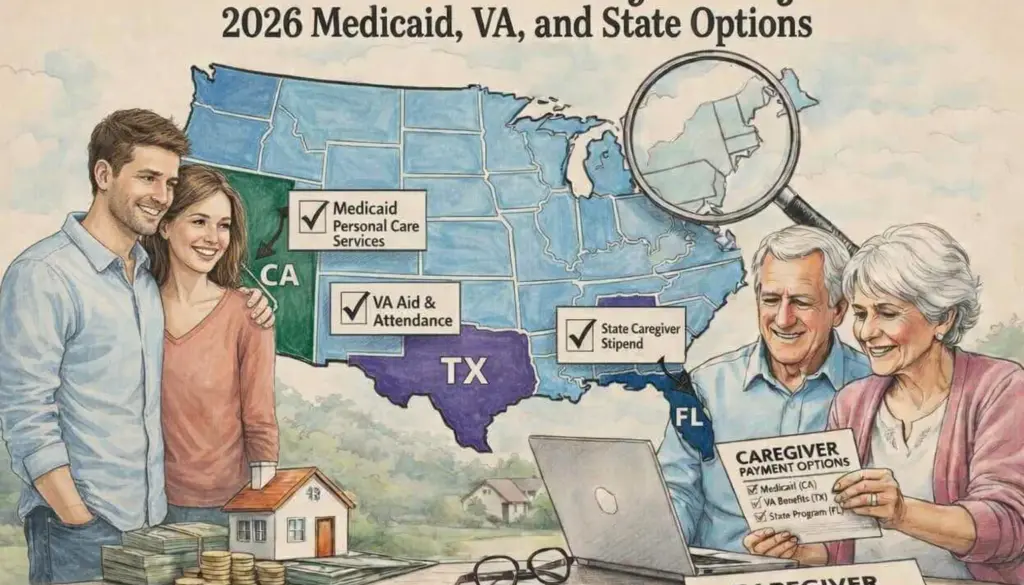
Can I Get Paid to Care for My Elderly Parent?
Written & Reviewed by


Last updated: March 19, 2026
Bottom Line: Yes, sometimes you can get paid to care for an elderly parent, but the money usually comes from Medicaid home-care programs, a few large state programs, the VA caregiver program, or short-term paid family leave. Medicare is usually not the answer for long-term daily caregiving.
In 2025, AARP and the National Alliance for Caregiving reported that 63 million Americans are caregivers. That is about 1 in 4 adults. The need is huge, but the rules are not simple, and many families lose time by applying to the wrong program first.
Emergency help now
- If your parent is in immediate medical danger, has fallen, is wandering, has no heat, or cannot be left alone safely, call 911 now.
- If you believe there is abuse, neglect, or exploitation, contact Adult Protective Services right away through your local agency or the Eldercare Locator at 1-800-677-1116.
- If the crisis is that there is no caregiver available today, call your local Area Agency on Aging or Aging and Disability Resource Center through the Eldercare Locator at 1-800-677-1116 and ask for emergency respite or urgent in-home support options.
Quick help
- Fastest real path: If your parent already has Medicaid, call the case manager or health plan today and ask, “Does this program allow self-directed or participant-directed home care so a family member can be paid?”
- Best first call if you are not sure where to start: Contact the Eldercare Locator at 1-800-677-1116 to reach your local aging office.
- If your parent is a Veteran: Call the VA Caregiver Support Line at 1-855-260-3274.
- If you still have a job: Check whether your state offers paid family leave. In 2026, California Paid Family Leave and New York Paid Family Leave can replace part of your wages while you take time off to care for a parent.
- If you live in California, New York, Florida, or Texas: Jump to the state section below. Those states have important differences that many articles miss.
What paid family caregiving assistance for seniors actually looks like
Start here first: Check Medicaid before you quit your job or assume you must pay out of pocket. For most families, the main path to real caregiver pay is a Medicaid home-care program that lets the older adult choose their own worker.
These programs often use terms like self-directed, consumer-directed, or participant-directed. All three usually mean the same basic thing: the older adult, or someone legally allowed to act for them, can choose who provides care. That worker may be an adult child, another relative, a friend, or sometimes a spouse, depending on the state and the exact program.
The care itself is usually in-home personal care. That means help with bathing, dressing, toileting, walking, meal help, transfers, medication reminders, and supervision. These are often called activities of daily living, or ADLs. If your parent mainly needs this kind of help, Medicaid is far more relevant than Medicare. Medicare does not cover most long-term personal care, and even Medicare home health is limited and usually tied to skilled care.
Quick facts
- Best immediate takeaway: The biggest program for paying family caregivers is Medicaid home care, not Medicare.
- Major rule: Your parent usually must meet both care-need rules and financial rules.
- Realistic obstacle: Approval can take weeks or months, and some waiver programs have waitlists.
- Useful fact: Many states let an adult child be paid. Spouse rules are much more restricted and vary sharply by state.
- Best next step: Call your local aging office through the Eldercare Locator and ask for the exact home-care program that allows family caregiver pay in your state.
Who qualifies
There is no single national rule, but most paid family caregiver programs look for the same basic things.
- Your parent needs hands-on help or supervision: bathing, dressing, moving safely, eating, toileting, or help because of dementia or another disabling condition.
- Your parent is financially eligible for the program: for Medicaid, income and asset rules vary by state and by whether the program is regular Medicaid, a home-care waiver, or a managed care long-term care program.
- The program allows a family worker: adult children are often allowed; spouses are more limited; some programs bar legally responsible relatives and some do not.
- The care is delivered at home or in the community: these programs are designed to keep older adults out of nursing homes when safe home care is possible.
- The caregiver completes provider steps: this may include orientation, background checks, payroll forms, electronic visit verification, and timesheets.
If your parent is not on Medicaid yet, do not assume that means “no.” Some states offer regular Medicaid personal care with no waiver waitlist, and some people qualify after a spend-down, trust, or other state-specific pathway. Because that part is very case-specific, ask the local aging office or Medicaid office before making financial moves on your own.
Best assistance programs for seniors
Medicaid self-directed home care
- What it is: This is the main national path for getting paid to care for a parent at home. Under self-directed Medicaid services, the older adult can often choose who provides care.
- Who can get it: The parent must meet state Medicaid financial rules and be assessed as needing help with daily living. Family worker rules vary by state.
- How it helps: It can pay for personal care hours at home and sometimes related supports under a home and community-based services program.
- How to apply: Ask your state Medicaid office, managed care plan, or local aging office if the parent can use a self-directed or consumer-directed home-care option.
- What to gather: ID, Medicaid card, proof of income and assets, doctor information, medication list, and a written list of unsafe situations at home.
- Timeline: Assessments often take weeks. Waiver programs can take much longer if there is a waitlist.
California In-Home Supportive Services (IHSS)
- What it is: IHSS provides in-home help to eligible Californians as an alternative to facility care. If approved, the recipient hires the worker and the state issues payment.
- Who can get it: The parent must be a California resident, have a Medi-Cal eligibility determination, live at home, and submit a completed health care certification.
- How it helps: A family member, friend, or other provider may be paid for authorized hours. The exact hourly wage varies by county.
- How to apply: Submit the application through your county IHSS office. The county social worker will do a home visit and needs assessment.
- What to gather: Medi-Cal information, ID, doctor contact information, medication list, and the parent’s daily care needs. Providers also need orientation and a background check.
- Timeline: County timing varies. Do not expect pay before provider enrollment is finished.
New York Consumer Directed Personal Assistance Program (CDPAP)
- What it is: CDPAP lets an approved Medicaid member choose and direct their own personal assistant.
- Who can get it: The parent must be a Medicaid member approved for home care. A friend or family member can often be hired, but not the spouse, not the designated representative, and not the parent of a consumer under age 21.
- How it helps: It allows the family to keep a trusted caregiver instead of using only agency staff. New York moved to a single statewide fiscal intermediary, Public Partnerships LLC (PPL), effective April 1, 2025.
- How to apply: Use the official CDPAP page, contact the managed care plan or local department of social services, and call PPL at 1-833-247-5346 for registration help.
- What to gather: Medicaid number, date of birth, address, plan information, and caregiver details.
- Timeline: Expect delays if the assessment, authorization, or payroll registration is incomplete. Many older web pages are outdated because the 2025 transition changed how CDPAP is administered.
Florida Statewide Medicaid Managed Care Long-Term Care Program
- What it is: Florida’s SMMC Long-Term Care program provides home and long-term care services through managed care plans.
- Who can get it: The parent must meet both medical and financial eligibility rules. Florida says the person must generally be 65 or older, or 18 or older with a disability, and meet nursing-home level of care.
- How it helps: Plans cover in-home services and must offer the Participant Direction Option to eligible home-based enrollees. Florida’s current LTC waiver is more flexible than many states and can allow some legally responsible relatives, including a spouse, for certain services under participant direction and plan approval.
- How to apply: Start with the screening process or call the Elder Helpline at 1-800-963-5337. Florida says the screening call usually takes about 45 minutes to 1 hour.
- What to gather: ID, Medicaid information if any, doctor information, daily care needs, and financial records for Medicaid review.
- Timeline: The screening is fast. The waitlist is not. A good screening score does not mean immediate in-home pay.
Texas Consumer Directed Services
- What it is: Texas lets many long-term care programs use Consumer Directed Services, often called CDS. It can be used in programs such as Community Attendant Services and some STAR+PLUS home-care services.
- Who can get it: The parent must qualify for the underlying Texas Medicaid service. In Texas, the exact rules depend on the program, service area, and managed care setup.
- How it helps: The family can hire and manage the worker instead of relying only on an agency model. Texas also has Community Attendant Services, which the state describes as an entitlement program that can be requested at any time if the person meets the rules.
- How to apply: Use the Texas HHS service locator or ask about STAR+PLUS long-term services at 1-877-438-5658. Ask specifically whether your parent’s program allows CDS.
- What to gather: Medicaid information, doctor statement of need, ADL list, and caregiver identification.
- Timeline: Basic attendant care may move faster than broader waiver-style services. Do not assume every Texas long-term care service uses the same process.
VA Program of Comprehensive Assistance for Family Caregivers (PCAFC)
- What it is: The VA caregiver program can pay a monthly stipend to an approved primary family caregiver of an eligible Veteran.
- Who can get it: The caregiver must be at least 18. The VA says the caregiver must be a spouse, child, parent, stepfamily member, extended family member, or someone who lives with or will live full-time with the Veteran. The Veteran must also meet VA program rules, including a service-connected disability rating requirement.
- How it helps: Eligible primary caregivers may receive a monthly stipend, respite care, training, counseling, and sometimes CHAMPVA health coverage. The exact stipend amount varies. There is no single national monthly figure.
- How to apply: The Veteran and caregiver apply together online, by mail, or in person. Call the VA Caregiver Support Line at 1-855-260-3274.
- What to gather: Veteran information, caregiver information, direct deposit details, and records showing how much daily care the Veteran needs.
- Timeline: VA timing varies. Expect review, assessment, and training steps.
State paid family leave
- What it is: This is not long-term home-care pay. It is short-term wage replacement when you take time off from work to care for a family member.
- Who can get it: Only workers in states with paid leave programs, and only if they meet that state’s earnings and work rules.
- How it helps: In 2026, California Paid Family Leave can pay about 70% to 90% of wages for up to eight weeks. New York Paid Family Leave pays 67% of average weekly wages up to $1,228.53 per week in 2026, for up to 12 weeks.
- How to apply: Apply through the state leave agency or insurer. California uses the EDD caregiver claim process. New York uses the employer’s Paid Family Leave insurer and state forms.
- What to gather: Employer information, wage history, and medical certification that your parent needs care.
- Timeline: In New York, the insurer generally must pay or deny the request within 18 calendar days after a complete request or the first day of leave, whichever is later.
How to apply without wasting time
- Check the parent’s coverage first. Find out whether they already have Medicaid, a Medicaid managed care plan, VA coverage, or long-term care insurance.
- Ask one direct question. Say, “Does this program allow a family member to be the paid caregiver through self-direction or participant direction?”
- Start the medical need process early. Home-care pay usually depends on an assessment of how much help the parent needs at home.
- Start provider enrollment as soon as allowed. Background checks and payroll steps create real delays.
- Keep a written care log. List falls, wandering, missed medications, bathing problems, incontinence, and nighttime supervision needs.
- Ask about waitlists before you count on the money. Florida LTC and many waiver-type services can take time.
- Ask for language or disability help on the first call. If you need an interpreter, TTY support, large print, or in-person help, say so right away.
Application checklist
- ☐ Parent’s photo ID
- ☐ Medicaid card or Medicaid application information
- ☐ Social Security number or program ID
- ☐ Proof of income and assets if applying for Medicaid
- ☐ Doctor names, diagnoses, medication list, and recent hospital records
- ☐ Written list of daily tasks the parent cannot do safely alone
- ☐ Caregiver ID, address, and contact information
- ☐ Direct deposit and payroll information if the family caregiver will enroll as a provider
- ☐ Power of attorney or other legal papers if someone else must act for the parent
Reality checks
- Approval does not always mean enough hours. A parent may need round-the-clock help, but the program may approve far fewer paid hours.
- Waitlists are real. Florida’s LTC program uses a priority score and rank. Some other waiver programs in other states also have long backlogs.
- No pay usually starts until enrollment is complete. Fingerprints, orientation, timesheet systems, and direct deposit setup slow families down.
- Medicare is often the biggest dead end. It may cover limited skilled home health, but it does not usually pay a family member to provide long-term daily care.
Common mistakes to avoid
- Applying to Medicare instead of Medicaid. This wastes time for most long-term family caregiving cases.
- Not asking for the family-pay option by name. Many offices explain agency care first. You may need to ask for self-direction or participant direction.
- Assuming every relative can be paid. New York CDPAP, for example, does not allow a spouse to be the paid assistant.
- Waiting to collect documents. Missing medical proof or financial records is a common reason applications stall.
- Expecting back pay. Many programs do not pay for care given before approval and worker enrollment.
Example: A daughter may win home-care hours for her mother, but still wait weeks for pay because fingerprints, provider forms, or electronic visit verification were not done. The care was real, but the payroll steps were not finished.
Best options by need
| If you need… | Best first option | Why |
|---|---|---|
| Ongoing pay for an adult child caring at home | Medicaid self-directed home care | This is the main path to a real paycheck for daily personal care. |
| Help in California | IHSS | Large, well-known state program with county administration and paid family providers. |
| Help in New York | CDPAP | Lets the consumer choose the worker, but current transition rules matter. |
| Help in Florida | SMMC LTC screening | This is the entry point for home-based long-term care funding. |
| Short-term time off from work | State paid family leave | Useful if you need income quickly while you care for a parent. |
| A Veteran parent | VA caregiver support | The VA may offer a stipend and added caregiver supports. |
| Help while stuck on a waitlist | AAA/ADRC respite and caregiver support | Not usually a wage, but it can prevent burnout while you wait. |
How this help varies in major states
This topic varies a lot by state. The biggest differences are where you apply, whether there is a waitlist, whether family members can be hired, and how home care is administered.
| State | Best first contact | What changes in practice | Main warning |
|---|---|---|---|
| California | County IHSS office | IHSS is county-run and widely used. Family and friends can often be providers. County wage rates vary. | You still need Medi-Cal, a home visit, and provider enrollment. |
| Texas | Texas HHS locator or 1-877-438-5658 | Texas uses several long-term care pathways. Ask first about Community Attendant Services and whether CDS is available in your parent’s program. | Do not assume every home-care program in Texas follows the same rules. |
| Florida | LTC screening or 1-800-963-5337 | The first step is a phone screening through the aging network. Florida uses a priority rank and waitlist for many applicants. | The screening call is quick. Getting off the waitlist may not be. |
| New York | CDPAP page and PPL at 1-833-247-5346 | New York now uses one statewide fiscal intermediary, PPL. Old articles about many separate fiscal intermediaries are outdated. | Spouses cannot be paid under CDPAP. |
| Washington | DSHS caregiver FAQ | Washington personal care is available through Community First Choice for people who meet functional and financial rules. Individual providers are common. | Training, background checks, and worker setup still take time. |
| Pennsylvania | Apply for Community HealthChoices | Pennsylvania routes long-term services through Community HealthChoices managed care and participant-directed services. | The service model is less simple than a single statewide payroll program, so plan coordination matters. |
| Arizona | ALTCS offices or 1-888-621-6880 | Arizona uses ALTCS for people who need nursing-facility level care. Member-directed options, including Self-Directed Attendant Care, are available to many members living at home. | Application begins with ALTCS. Do not wait for Medicare to solve long-term care. |
If your application gets denied
First: get the denial in writing. Ask whether the problem was financial eligibility, medical need, missing documents, or provider eligibility. Those are very different problems.
- Ask for the exact rule used. Do not accept a vague “you do not qualify.”
- Ask whether more medical proof would help. A stronger doctor statement or better ADL notes can matter.
- Ask about appeal deadlines right away. They are often short.
- Keep copies of everything. Save forms, dates, names, and call notes.
Useful contacts: For California hearings, call 1-800-743-8525. For Florida LTC complaints and hearing information, call 1-877-254-1055. For VA caregiver help, call 1-855-260-3274. If you need free legal help, try the Legal Services Corporation legal aid finder.
Backup and other options
- Area Agency on Aging and caregiver support: The National Family Caregiver Support Program can help with respite, counseling, caregiver training, and limited supplemental services. It is usually not a paycheck, but it can keep a family going while Medicaid is pending.
- Private pay with a written caregiver agreement: If your parent has income or savings, a written personal care agreement may let them pay you legally. Do not do this casually. Poorly documented payments can create tax problems or later Medicaid issues. Review IRS Publication 926 and consider elder-law advice.
- Short-term wage replacement: If you cannot stop working with no income, paid family leave may be the bridge while you arrange long-term care.
- Respite while waiting: Ask your local aging office about respite, adult day care, home-delivered meals, transportation, and caregiver training through the Eldercare Locator.
Diverse communities
- Seniors with Disabilities: Start with Medicaid home and community-based services, not general senior programs alone. A local Aging and Disability Resource Center can help compare home-care and disability support options.
- Veteran Seniors: Ask both about the VA caregiver stipend program and the broader VA general caregiver supports. Many families qualify for support even when they do not qualify for the stipend.
- Immigrant and Refugee Seniors: Do not assume one office’s answer applies to every program. Medicaid rules for noncitizens are complex, but local aging offices may still connect families to respite, meals, caregiver training, and interpreter help. Ask for language access on the first call.
- Tribal-Specific Resources: Tribal elders and caregivers may have help through tribal aging programs, tribal health systems, or caregiver programs supported through the Administration for Community Living. Ask your tribal clinic or tribal social services office which program should be first.
- Rural Seniors with Limited Access: Ask whether screening can start by phone and whether a case manager can arrange a home visit. Some states, including Washington, are using options like remote caregiving for certain tasks, but in-person help is still limited in many rural counties.
- LGBTQ+ Seniors: If safety or discrimination is a concern, ask for a case manager who understands LGBTQ+ aging issues. The nonprofit SAGE can also help families find affirming aging resources.
Frequently asked questions
Can Medicare pay me to care for my mom or dad at home?
Usually no. Medicare does not pay for most long-term personal care. It may cover limited home health services when skilled care is needed, but that is not the same as paying a relative to handle daily bathing, dressing, supervision, and meal help over the long run.
Can a spouse get paid?
Sometimes, but this is one of the most state-specific parts of the whole topic. New York CDPAP does not allow a spouse. Florida’s current LTC waiver is more flexible and can allow some legally responsible relatives under participant direction. In other states, spouse rules are tighter or depend on the exact sub-program. Always ask before relying on spouse pay.
How much do family caregivers get paid?
There is no single national rate. Pay depends on the number of approved hours, the wage rate in the county or plan, and the type of service. In California IHSS, the county determines the hourly rate. In VA PCAFC, the stipend varies by approval level and local wage data. In paid family leave programs, the payment is based on your wages, not on hours of caregiving.
How long does it take to get approved?
It varies widely. Florida says the first screening call usually takes 45 minutes to 1 hour, but the waitlist can be much longer. California requires a county home visit and provider enrollment. New York home-care approvals can slow down if plan authorization or PPL registration is incomplete. VA cases also take time because there are review and training steps.
Can I get back pay for care I already gave?
Do not count on it. Many programs only pay after services are approved and the caregiver is fully enrolled. Ask this question early, in writing if possible. Families often provide months of unpaid care while waiting, so it is safer to assume back pay is limited or unavailable unless the program says otherwise.
Can my parent just pay me directly?
Yes, sometimes that is the right backup plan, especially if your parent is not Medicaid-eligible or is stuck on a waitlist. But it should be done with a written caregiver agreement, clear records, and tax guidance. If you skip the paperwork, you can create family conflict, audit problems, or later Medicaid trouble. Review IRS household employment rules and get professional advice if large sums are involved.
Resumen en español
Sí, a veces un hijo, hija, cónyuge u otro familiar puede recibir pago por cuidar a un adulto mayor en casa. La vía más importante suele ser Medicaid con servicios dirigidos por el participante, no Medicare. Si su padre o madre ya tiene Medicaid, pregunte de inmediato si el programa permite que un familiar sea el cuidador pagado.
Si vive en California, revise IHSS. Si vive en Nueva York, revise CDPAP. En Florida, el primer paso es la evaluación del programa de cuidado a largo plazo y puede llamar al 1-800-963-5337 o usar la página oficial de evaluación.
Si su padre o madre es veterano, llame al programa de apoyo para cuidadores del VA al 1-855-260-3274 o visite la página oficial del VA. Si usted trabaja y necesita tiempo libre, también revise si su estado ofrece licencia familiar pagada. Para ayuda local, use el Eldercare Locator al 1-800-677-1116 y pida una agencia local para adultos mayores o discapacidad.
About This Guide
This guide uses official federal and state sources, along with other high-trust nonprofit and community resources mentioned in the article.
Editorial note: This guide is produced based on our Editorial Standards using official and other high-trust sources, regularly updated and monitored, but not affiliated with any government agency and not a substitute for official agency guidance. Individual eligibility outcomes cannot be guaranteed.
Verification: Last verified March 19, 2026, next review July 19, 2026.
Corrections: Please note that despite our careful verification process, errors may still occur. Email info@grantsforseniors.org with corrections and we respond within 72 hours.
Disclaimer: This article is for informational purposes only. It is not legal, financial, disability-rights, immigration, veterans-benefit, or government-agency advice. Program rules, policies, and availability can change. Always confirm current details directly with the official program, plan, insurer, or agency before you apply, spend money, leave a job, transfer assets, or rely on a benefit.
About the Authors