

Property Tax Relief for Seniors in Alabama (2026 Guide)
Written & Reviewed by


Last updated: 22 March 2026
Bottom line: In Alabama, turning 65 does not automatically erase every property tax bill. The main help is a homestead exemption filed through your county tax office, and the result depends on your income, disability status, and where you live. Some older homeowners get the state tax removed. Some get a bigger county break. Some qualify for a full exemption. A few counties also have local tax-freeze rules.
If you may lose your home over taxes this month
- Call your county tax office today through the Alabama Department of Revenue county office finder and ask for your exact balance, delinquency status, and whether an exemption can still be fixed or added.
- Call 2-1-1 now for emergency local referrals. 211 Connects Alabama can be reached by dialing 2-1-1, calling 1-888-421-1266, or texting your ZIP code to 898-211.
- If title, probate, or denial issues are blocking help, contact Legal Services Alabama’s call center at 1-866-456-4995, or ask your local Aging and Disability Resource Center for a legal-aid referral at 1-800-243-5463.
Fastest ways to cut the bill
- If you are already 65 or older, file or review your homestead status now. Apply through your county office and ask which code fits: H-2, H-3, or H-4.
- Bring both returns. Alabama uses your state return for one senior income test and your federal taxable income for another.
- Ask about county-specific freezes if you live in Baldwin County, Jefferson County, or Lauderdale County.
- Check whether the automatic 7% cap applies. Alabama says eligible Class II and Class III real property can get the 7% assessed-value cap with no application.
- If your taxes are escrowed, send the approval to your mortgage company. Otherwise your monthly payment may stay too high even after the county fixes the tax record.
What Alabama relief really looks like
Property-tax help in Alabama is more complicated than many websites make it sound. The state calls property tax ad valorem tax. Your bill is based on assessed value, not just your home’s market value, and local millage rates decide how much each exemption is worth. That is why two seniors with similar homes can owe very different amounts in different counties or cities. The Alabama property tax assessment page explains that owner-occupied residential property is generally Class III property and is assessed at 10% of appraised value before rates and exemptions are applied.
This matters because Alabama’s relief is layered. A senior with higher income may only remove the state portion. A lower-income senior may also reduce county taxes. A very low-income senior, or a person who is permanently and totally disabled, may remove all state, county, and city property taxes on a principal residence. Some counties also freeze assessed value for eligible older owners. And as of the most recent U.S. Census Bureau QuickFacts for Alabama, 18.5% of Alabama residents were age 65 or older, while the state’s owner-occupied housing rate was 70.2%, so these rules affect a large share of older households.
| Relief type | Does Alabama have it? | What seniors should know |
|---|---|---|
| Homestead exemption | Yes | Available through your county office on an owner-occupied principal residence under the state homestead rules. |
| Senior exemption | Yes | Age 65 and over can remove all state property tax, and may qualify for more county or full relief depending on income and other rules. |
| Full low-income senior exemption | Yes | The H-3 path can remove all ad valorem taxes on the principal residence if combined federal taxable income is $12,000 or less. |
| County-specific senior freeze | Sometimes | Examples include Baldwin County, Jefferson County, and Lauderdale County. |
| Statewide circuit-breaker credit | No statewide program found | In the current official Alabama homestead materials and property-tax relief pages reviewed for this guide, we did not find a statewide homeowner circuit-breaker credit. |
| Statewide senior rebate | No statewide program found | Alabama’s main homeowner relief path is still exemptions, not a statewide cash rebate. |
| Statewide homeowner deferral | No routine statewide program found | We did not find a current statewide deferral program for ordinary senior homeowners in the official property-tax materials reviewed as of March 2026. |
| 7% cap on assessed-value increases | Yes | The 7% cap applies automatically to eligible Class II and Class III real property, but it is not a senior-only program and it does not freeze millage rates or separate fees. |
Important: If you came looking for an Alabama property-tax rebate, circuit-breaker, or deferral for seniors, the official programs you are most likely to use right now are the homestead and principal-residence exemptions, some county-specific rules, and the automatic 7% cap.
Five facts that matter most
- Best takeaway: The biggest money-saving move is to file with your county tax office and ask what code is already on your home.
- Major rule: Your home must be your single-family, owner-occupied principal residence, generally on the October 1 lien date, and the land is limited to 160 acres under the state homestead rules.
- Real obstacle: Many seniors bring only one tax return. That causes problems because H-2 uses Alabama income rules while H-3 uses combined federal taxable income.
- Useful fact: Dollar figures like $2,000 or $5,000 are assessed-value exemptions, not cash checks. Your actual savings depend on local tax rates.
- Best next step: If you live in a fast-growing county, ask both about your homestead code and whether a local senior freeze or the 7% cap is already helping you.
Who can qualify in Alabama
Start with the basic rule. Alabama defines a homestead as a single-family owner-occupied dwelling and the land that goes with it, up to 160 acres. You generally must own the property and live there as your primary residence on the first day of the tax year you are claiming. You apply through your county tax assessor or revenue commissioner, not through a state online form.
Second homes, rentals, and investment property usually do not qualify. If you moved out, rent the home, or changed title in a way that breaks owner-occupancy, your senior exemption can stop. If one owner qualifies and the property is jointly owned, Alabama’s homestead rule says the property gets the full exemption; there are no partial homestead exemptions.
Non-filers should not give up. Alabama’s official materials allow “some other appropriate evidence” in some cases, so if you do not normally file because your income is low, ask your county office what proof they will accept before you leave home.
| Code | Main test | What it usually does |
|---|---|---|
| H-4 | Age 65 or older, with income above the low-income state test | Removes all state property tax and gives the regular county homestead exemption on county taxes. |
| H-2 | Age 65 or older, with Alabama adjusted gross income under $12,000 on the most recent state return | Removes all state property tax and up to $5,000 of assessed value on county taxes, including school taxes. |
| H-3 | Age 65 or older, with combined federal taxable income of $12,000 or less | Exempts the principal residence from all ad valorem taxes: state, county, and city. |
Do not confuse H-2 and H-3. The H-2 test uses Alabama return lines. The H-3 test uses the combined taxpayer-and-spouse federal taxable income rule. This is one of the biggest reasons seniors get the wrong answer at the counter.
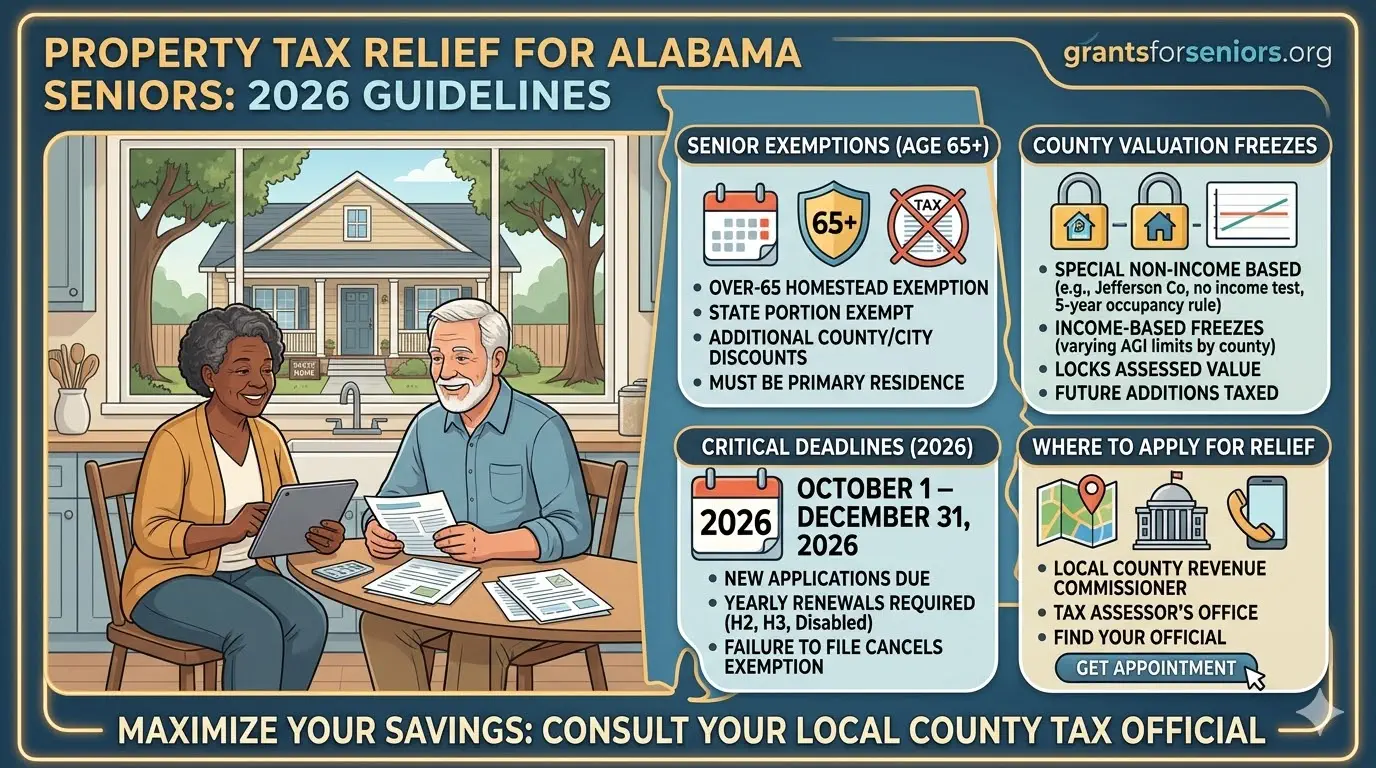
Main Alabama property-tax relief options
Statewide homestead and principal-residence exemptions
- What it is: Alabama’s main statewide property-tax relief for seniors. It is explained on the Alabama Department of Revenue homestead page.
- Who can get it: Older homeowners on a principal residence. Seniors age 65 and over can at least remove all state property tax. Lower-income seniors may qualify for H-2 or H-3. A person who is permanently and totally disabled may qualify for full relief regardless of age or income under the state rule.
- How it helps: Depending on the code, relief can mean a lower bill, a bigger county exemption, or no ad valorem tax at all on the principal residence.
- How to apply: Apply with your county tax office. Alabama’s rule says you may apply October 1 through December 31 for the current year, or later in the year for the following year.
- What to gather: Photo ID, deed or parcel number, proof you live there, your latest Alabama return, your latest federal return, and disability proof if that path applies. If you need physician proof, use the official Physician’s Affidavit of Permanent & Total Disability.
Baldwin County over-65 assessment freeze
- What it is: Baldwin County has a local senior property-tax appraisal rule that freezes the assessed value of the property for the year before you claim it.
- Who can get it: You must be 65 or older as of October 1 and must have maintained property in Baldwin County as your principal residence for at least 10 years. The rule says that residency can be cumulative, not necessarily 10 straight years.
- How it helps: It can hold down future tax growth tied to rising assessed value, but you still remain subject to millage rate changes.
- How to apply: Baldwin County says the over-65 assessment freeze is handled with its exemption process. Call the Revenue Commission at 251-937-0245.
- What to gather: Driver’s license or proof of age, proof of principal residence, parcel details, and records that show the required county residency history if asked.
Jefferson County special senior property tax exemption
- What it is: Jefferson County has a local senior exemption created by Act 2021-300. The county’s own FAQ says it is in addition to the normal over-65 exemption and it freezes taxes for the next applicable year once claimed.
- Who can get it: A taxpayer age 65 or over who owns and uses the home as a principal residence and has owned and lived on it for at least five consecutive years before first claiming it. Jefferson County’s FAQ says income is not a qualification for this local special exemption.
- How it helps: It freezes assessed value, but the property still stays subject to millage changes and taxes on later additions.
- How to apply: Contact the Jefferson County Tax Assessor at 205-325-5505. The county also says the special senior exemption stays on the property if you keep renewing the over-65 exemption each year.
- What to gather: Proof of age, deed, proof the home is your principal residence, records showing the five-year ownership and occupancy requirement, and your regular over-65 homestead paperwork.
Lauderdale County senior property tax exemption
- What it is: Lauderdale County has a local senior exemption created by Act 2024-136 / HB40. Like Jefferson’s, it freezes the home’s assessed value at the year before you first claim it.
- Who can get it: A homeowner age 65 or older who owns a single-family owner-occupied home used as a principal residence for at least five years immediately before the first claim year.
- How it helps: It can limit growth tied to value increases, but the law says the property still remains subject to millage rate changes and taxes on later additions.
- How to apply: The act says the exemption may be claimed in writing between October 1 and December 31 with the Lauderdale County Revenue Commissioner. Contact the office at 256-760-5785 or start with the county website.
- What to gather: Proof of age, deed, parcel number, proof the property has been your principal residence for the required five-year period, and any regular homestead records.
Alabama’s automatic 7% cap on assessed-value increases
- What it is: A statewide 7% cap on annual increases in taxable assessed value for eligible Class II and Class III real property.
- Who can get it: Eligible property owners automatically. It is not senior-only.
- How it helps: It can slow tax growth in rising markets. Alabama says no application is needed.
- How to apply: You do not apply. Review your notice and ask your county office whether the cap was applied correctly.
- What to gather: Your valuation notice, prior year tax record, and proof of any ownership change, improvement, or class change. Alabama says changes in ownership, new additions, and significant improvements can remove the cap, and the cap also does not freeze separate fees like fire or garbage charges.
| County | Why it matters | Key rule | Contact |
|---|---|---|---|
| Baldwin | Local over-65 freeze | Age 65+ and at least 10 years of county principal-residence history for the assessment freeze | Exemptions page, 251-937-0245 |
| Jefferson | Special senior exemption on top of over-65 relief | Age 65+, principal residence, and five consecutive years before first claim; no income test in county FAQ | County FAQ, 205-325-5505 |
| Lauderdale | Local senior exemption/freeze | Age 65+, principal residence, five years immediately before first claim, written filing from October 1 to December 31 | Act text, 256-760-5785 |
| Mobile | Good example of access options | Mobile County says some homestead applications can be handled by mail or email, and renewal forms are due by December 31 | 251-574-8530 |
Apply the smart way
- Check your current tax code first. Use your county’s online record search from the state county office page, or call and ask what exemption code is already on file.
- Bring both tax returns. This saves the most time because Alabama uses different income tests for different senior exemptions.
- Ask one direct question: “Do I qualify for H-2, H-3, H-4, a disability exemption, or a county senior freeze?”
- File before December 31 if you owned and lived in the home on October 1. Alabama says taxes are due October 1 and delinquent after December 31.
- If travel is hard, ask about remote options. Mobile County’s homestead page is a useful example of a county that allows some applications by email or mail.
- After approval, fix your escrow. Send your updated tax bill or approval letter to your mortgage servicer and ask for a new escrow analysis.
Application checklist
- ☐ Proof of age, such as a driver’s license or state ID
- ☐ Deed, parcel number, or property tax statement
- ☐ Proof the home is your primary residence
- ☐ Latest Alabama income tax return
- ☐ Latest federal income tax return for you and your spouse, if married
- ☐ Disability pension letter, agency letter, or the PT-PA-1 physician affidavit, if using a disability path
- ☐ Any county renewal form you were mailed
- ☐ Mortgage company contact information if your taxes are escrowed
Reality checks before you count on savings
- Turning 65 usually removes the state portion. It does not automatically mean your entire property tax bill goes away.
- A freeze does not freeze everything. County freeze laws still allow millage rate changes, and later additions like new rooms or pools can still raise tax.
- Missing a bill does not stop delinquency. Alabama says the county is not required to mail tax notices, and you still owe the tax even if a statement never arrives.
- County rules can be sharply different. A senior in Jefferson or Baldwin may have local options a senior in another county does not have.
Common mistakes that delay or kill an exemption
- Bringing only one return. H-2 and H-3 use different income tests.
- Forgetting the spouse’s federal return information. H-3 looks at combined federal taxable income.
- Assuming an assessed-value exemption is a cash rebate. It lowers the taxable value first. Savings differ by local tax rate.
- Changing the deed without checking the tax effect. Title changes can affect homestead eligibility, local freezes, and the 7% cap.
- Ignoring renewal or verification mail. Some counties send renewal forms instead of a bill for certain exemptions.
- Adding an adult child to the deed to “help out” without advice. That can create new title problems, probate issues, or changes in tax treatment later.
Best options by need
- I need the biggest possible tax cut: Ask about H-3 first, then H-2, then H-4.
- My income is too high for the low-income rules: Make sure you still get the regular over-65 state exemption, then ask about any county freeze and the 7% cap.
- My home’s value jumped fast: Review whether the 7% cap applied, and if the market value itself looks wrong, ask about a Board of Equalization review.
- I cannot travel to the courthouse: Call first and ask about mail, email, or annual mail verification options.
- My parent needs help with forms: Adult children and caregivers should gather both returns, proof of occupancy, and title papers before the visit.
If the county says no
- Ask exactly why. Was the problem age, income, ownership, residency, missing paperwork, or a missed deadline?
- If H-3 is denied for income, ask about H-2 or H-4. A denial under one code does not always mean no relief at all.
- If the issue is property value, not the exemption, ask about the Board of Equalization. Alabama says BOE appeals still deal with fair market value disputes.
- If the issue is title, probate, or heirs property, get legal help fast. Call Legal Services Alabama at 1-866-456-4995.
- Keep notes. Write down the name of the person you spoke with, the date, and what documents they said were missing.
If the main route does not fix the bill
- Use the 7% cap if it fits. It is automatic, but county records can still be wrong.
- Look for local help with paperwork and crisis referrals. Your Area Agency on Aging and Aging & Disability Resource Center can help screen for services and application support.
- Ask 2-1-1 for short-term housing or financial referrals. They can point you to local charities, church assistance, and emergency help lines.
- If you need paid legal advice, use the Alabama State Bar Lawyer Referral Service. The referral page says the first 30-minute meeting costs no more than $50. Call 1-800-392-5660.
Local help that can make this easier
- Alabama Area Agencies on Aging and ADRCs: The Alabama Department of Senior Services ADRC page says these centers provide information, application help, legal-assistance referrals, and crisis support. Call 1-800-243-5463.
- IRS Tax Counseling for the Elderly and AARP Tax-Aide: The IRS free tax preparation page says adults 60 and older can use Tax Counseling for the Elderly. To find a nearby AARP Tax-Aide site during tax season, call 1-888-227-7669.
- 211 Connects Alabama: 211 is statewide and can connect you to local nonprofits, church aid, food help, housing counseling, and crisis support. It is free. If you are hearing-impaired, the 211 FAQ says you can call 7-1-1 and ask to be connected to 2-1-1.
- County tax offices: For Alabama property-tax relief, the most important local office is still your own assessing office.
Diverse communities
- Seniors with disabilities: Alabama’s principal-residence exemption rule can exempt all property taxes for a person who is permanently and totally disabled, regardless of age or income. If you do not have an agency disability letter, ask about the official physician affidavit.
- Veteran seniors: If you are retired due to permanent and total disability, the same Alabama disability exemption path may apply. Bring any disability pension or annuity paperwork and ask the county what extra proof is needed.
- Rural seniors with limited access: Do not assume you must always appear in person. Ask your county whether it accepts mail or email documents, and use your regional Area Agency on Aging for transportation or application help.
Other options if the main route still does not work
- Manufactured home owners age 65 and over: Alabama says owners over 65 are exempt from the registration fee on an owner-occupied manufactured home.
- Escrow correction: If your lender keeps charging the old amount, send the county’s updated tax record and request an immediate escrow review.
- Paid legal review: If you are deciding whether to change title, create a life estate, or transfer a share to a child, talk with a lawyer first. This can cost money, but it can prevent a much larger mistake later.
Frequently asked questions
Do seniors in Alabama stop paying property tax at 65?
No. In Alabama, age 65 or older usually removes the state portion of property tax under the state homestead rules, but county, school, and city taxes may still be due. To get more relief, you may need to qualify for H-2, H-3, a disability-based exemption, or a county-specific freeze. That is why asking only, “Do I pay taxes after 65?” often gets an incomplete answer.
What is the difference between H-2, H-3, and H-4?
H-4 is the common over-65 path for seniors whose income is too high for the low-income rules. It removes the state portion and gives the regular county homestead break. H-2 uses your Alabama return and can remove all state tax plus up to $5,000 of assessed value on county taxes. H-3 uses your combined federal taxable income and can wipe out all ad valorem tax on the principal residence.
Does Alabama have a statewide senior property-tax freeze, rebate, or circuit-breaker credit?
There is no statewide senior rebate or circuit-breaker homeowner credit listed in the current official Alabama property-tax materials reviewed for this guide. Alabama’s real statewide tools are the homestead and principal-residence exemptions and the automatic 7% assessed-value cap. Separate county freezes do exist in some places, including Baldwin, Jefferson, and Lauderdale, but they are local, not statewide.
When do I need to apply for Alabama senior property-tax relief?
Under Alabama’s homestead rule, the owner of homestead property as of the October 1 lien date may apply between October 1 and December 31 for the current year, or may apply during the year for the following year. Also remember that Alabama says property taxes are due October 1 and delinquent after December 31. If you missed the current-year window, still ask the county how to protect next year now.
What should I do if my mortgage company keeps charging the old tax amount?
Do not wait for the lender to notice the change. Ask the county office for an updated bill, tax record, or approval notice, then send it to your mortgage servicer and request a new escrow analysis. This problem is common after a first-time senior exemption or a county freeze. The tax office fixes the county record, but your monthly mortgage payment may stay too high until the lender updates its own file.
I live in a manufactured home. Is there any extra age-based relief in Alabama?
Yes, possibly. Alabama says an owner over age 65 is exempt from the registration fee on an owner-occupied manufactured home. That is separate from ordinary real-property homestead rules. If your manufactured home is taxed or registered differently in your county, ask both the county office and the manufactured-home desk what records they need so you do not miss the right form.
Can a title change after a spouse dies or after adding a child to the deed affect relief?
Yes. Homestead relief depends on ownership and occupancy. Also, Alabama’s 7% cap rules say some ownership changes remove the cap, though certain transfers between spouses or family members for no or nominal consideration, or because of the original owner’s death, do not count as ownership changes for cap purposes. Because local freezes and title rules can be tricky, ask the county office before recording a deed change.
Resumen en español
En Alabama, cumplir 65 años no significa que todos los impuestos de propiedad desaparecen. La ayuda principal es la exención de homestead del estado, pero el resultado depende de sus ingresos, si la casa es su residencia principal y si su condado tiene reglas locales especiales. Para muchas personas mayores, el paso más importante es llamar a la oficina de impuestos del condado y preguntar si califican para H-2, H-3, H-4 o una congelación local.
Si necesita ayuda para reunir papeles o entender el proceso, llame a su Area Agency on Aging / ADRC al 1-800-243-5463. Si tiene una crisis de vivienda o necesita referencias locales, use 211 Connects Alabama al 2-1-1 o 1-888-421-1266. Si el problema es legal, de título o de sucesión, contacte a Legal Services Alabama al 1-866-456-4995. Lleve su declaración estatal y federal más reciente, prueba de edad y documentos de la casa para no perder tiempo.
About This Guide
This guide uses official federal and state sources, along with other high-trust nonprofit and community resources mentioned in the article.
Editorial note: This guide is produced based on our Editorial Standards using official and other high-trust sources, regularly updated and monitored, but not affiliated with any government agency and not a substitute for official agency guidance. Individual eligibility outcomes cannot be guaranteed.
Verification: Last verified 22 March 2026, next review 22 July 2026.
Corrections: Please note that despite our careful verification process, errors may still occur. Email info@grantsforseniors.org with corrections and we respond within 72 hours.
Disclaimer: This article is for informational purposes only. It is not legal, financial, disability-rights, immigration, veterans-benefit, or government-agency advice. Program rules, policies, deadlines, and availability can change. County and city practices can differ sharply. Always confirm current details directly with the official program or county office before you act.
About the Authors