

Property Tax Relief for Seniors in Florida in 2026
Written & Reviewed by


Last updated: 21 March 2026
Bottom line: Most Florida senior property tax help comes through the homestead exemption system, the Save Our Homes cap and portability rules, local senior exemptions that counties and cities choose to adopt, and the homestead tax deferral program. Florida does not currently show a broad statewide senior rebate or circuit-breaker credit in the statewide guides we reviewed, so the fastest way to save money is usually to find your correct local office through the official county property tax contacts page and file the right form on time.
Emergency help now
- If your tax bill may go delinquent, call your county tax collector today through the official county finder and ask about partial payments, installment plans, or homestead tax deferral. In Florida, unpaid property taxes usually become delinquent on April 1.
- If your homestead or senior exemption was denied or never filed, call your county property appraiser today and ask whether late filing or an appeal is still open. Florida’s appeal guidance says deadlines stay strict even if you are still talking with the office.
- If you are at risk of losing your home or need legal help fast, call the Florida Senior Legal Helpline at 1-888-895-7873 through the official program page and ask your local Aging and Disability Resource Center for housing-cost help.
Quick help
- Start with homestead: If the home is your permanent Florida residence, file through your county property appraiser.
- Check the senior income test next: For the 2026 tax year, the Florida Department of Revenue lists the limited-income senior exemption limit at $38,686 in 2025 household adjusted gross income.
- Do not assume your county or city offers the same benefit as the next one: Florida’s extra senior exemptions are local-option programs.
- If you missed the regular 2026 filing deadline, act now: counties generally accept late-filed exemption applications only until the 25th day after the TRIM notice is mailed, and counties such as Broward publish an absolute late-file date.
- If the bill is still too high, ask the tax collector about deferral: seniors 65 and older may be able to defer part or even all of the bill under the rules in Form DR-570.
What property tax relief for seniors in Florida actually looks like
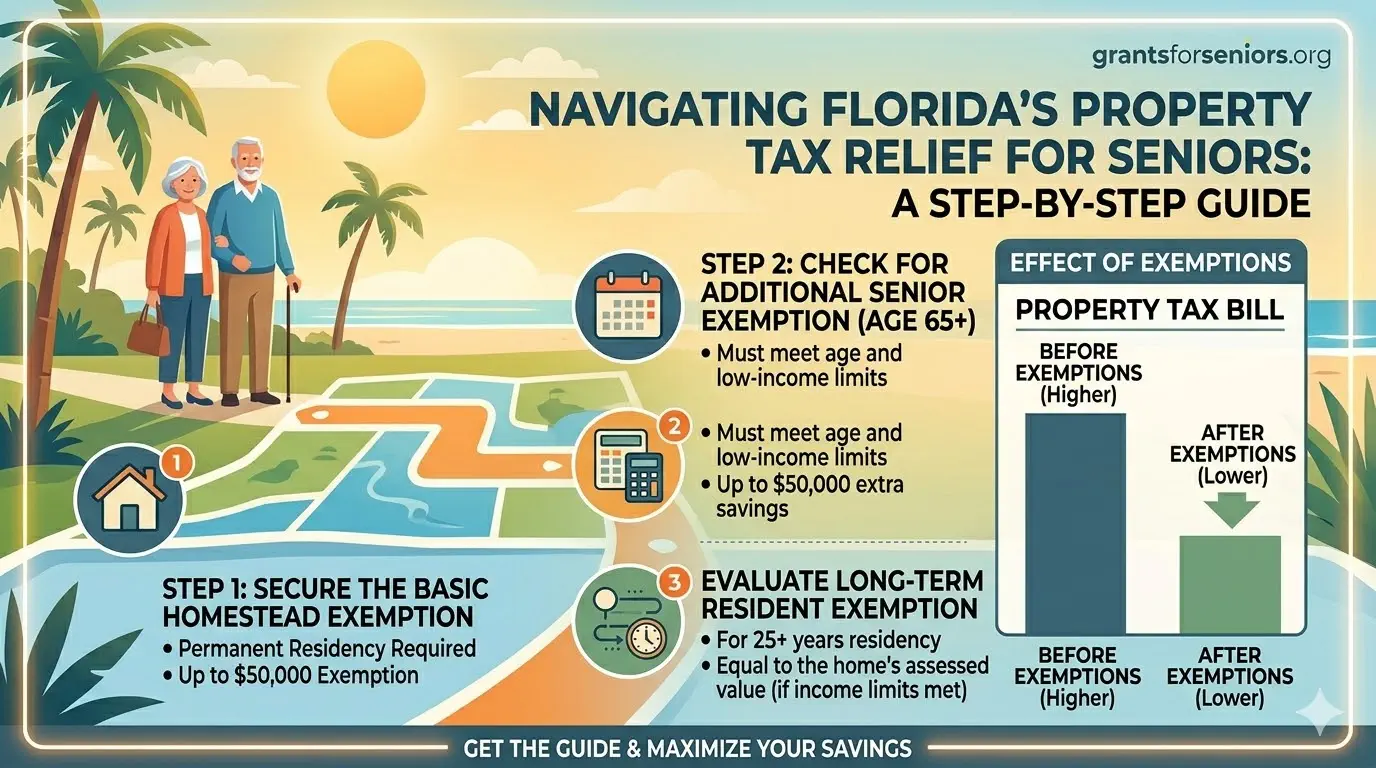
First action: File for homestead before you chase anything else. In Florida, most senior relief starts with the homestead exemption. If you do not have homestead, you usually cannot get the extra low-income senior exemption, the long-term resident senior exemption, or most of the practical protection that older homeowners depend on.
What you actually get: In Florida, relief usually means a lower taxable value, not a check in the mail. The statewide homestead exemption still begins with $25,000 off all property taxes, and for 2026 the state lists an inflation-adjusted second homestead amount of up to $26,411 on non-school taxes. After that, your county or city may add a senior exemption if it adopted one.
The “freeze” Florida seniors hear about: Florida’s closest statewide version of a tax freeze is the Save Our Homes assessment limitation. It does not freeze the bill in place. Instead, after the first homestead year, it limits how much the assessed value can rise each year. Local tax rates can still change, so bills can still go up.
Why this matters in Florida: Older adults make up 21.8% of Florida’s population, and many are homeowners on fixed incomes. That is why Florida’s rules can help a lot, but only if you know which office handles what and whether your county or city actually adopted the extra senior break.
Quick facts
- Best immediate takeaway: Get homestead first, then ask whether your county or city adopted the extra senior exemption.
- Major rule: The extra senior exemptions are local-option benefits, not automatic statewide benefits.
- Realistic obstacle: Many seniors call the wrong office. The property appraiser handles exemptions, the tax collector handles bills and deferrals, and the Value Adjustment Board handles appeals.
- Useful fact: Florida’s long-term resident senior exemption can wipe out the assessed value for a participating county or city levy, but only if the home met the 25-year, age, income, and first-year value rules.
- Best next step: Use the Florida property tax forms page and your county contacts page together so you file the right form with the right office.
Who qualifies
Basic homestead rule: You generally must own the home and make it your permanent residence as of January 1, then file with the county property appraiser using Florida’s homestead guidance.
Senior exemption rule: For the extra low-income senior exemption, at least one owner must be 65 or older, the home must already qualify for homestead, and household income must be at or below the current state income limit. For 2026, that limit is $38,686 in 2025 household adjusted gross income.
Long-term senior rule: The stronger long-term resident exemption adds more tests. The owner must meet the low-income senior rules, be 65 or older, have lived there for at least 25 years, and the property must have had a just value under $250,000 in the first year of eligibility.
Residency and paperwork rule: County offices usually want proof that Florida is really your home, such as a Florida driver license or ID, Social Security numbers, and sometimes trust papers if the home is in a trust, as explained in the state homestead guide. Some county sites also note that people in temporary visa status cannot establish permanent residence for homestead purposes, while lawful permanent residents may qualify with a green card, as shown by Hillsborough County’s guidance.
Who handles what
| Office | What it handles | Where to start |
|---|---|---|
| Property appraiser | Homestead, senior exemptions, portability, value questions | County property appraiser finder |
| Tax collector | Tax bills, partial payments, installment plans, deferrals | County tax collector finder |
| Value Adjustment Board (VAB) | Appeals of denied exemptions, values, portability, and deferrals | Florida VAB guide and your county clerk or VAB link |
Best assistance programs for seniors
Florida Homestead Exemption
- What it is: The main statewide break for owner-occupied primary homes under the Florida homestead rules.
- Who can get it: Owners with legal or equitable title who made the property their permanent residence by January 1 and are not claiming a similar exemption elsewhere.
- How it helps: For 2026, it includes $25,000 off all taxes plus an inflation-adjusted second piece up to $26,411 on non-school taxes.
- How to apply: File Form DR-501 with your county property appraiser.
- What to gather: ID, Social Security numbers, Florida residency proof, deed information, and trust papers if the home is in a trust.
Save Our Homes and portability
- What it is: A cap on annual assessed-value increases after homestead is approved, plus a way to transfer that tax benefit to a new Florida homestead under Florida portability rules.
- Who can get it: Homestead owners; portability is for owners moving from one Florida homestead to another.
- How it helps: It can slow future tax growth and protect seniors who downsize or move closer to family.
- How to apply: The cap is automatic after homestead approval. Portability requires Form DR-501T with the new homestead application.
- What to gather: Old and new parcel information, ownership dates, and any papers showing when the old homestead was abandoned.
Low-Income Senior Additional Homestead Exemption
- What it is: A local extra exemption for seniors age 65 and older under section 196.075 guidance.
- Who can get it: Homesteaded owners age 65+ whose 2025 household adjusted gross income is no more than $38,686 for the 2026 tax year, but only where the county or city adopted the benefit.
- How it helps: It can reduce participating county or city taxes by up to $50,000 of taxable value. It does not reduce school taxes.
- How to apply: File Form DR-501SC with your property appraiser and ask whether your county or city adopted the program.
- What to gather: Federal returns, W-2s, SSA-1099 forms, age proof, and income records for everyone in the household except renters or boarders.
Long-Term Resident Senior Exemption
- What it is: A stronger local exemption for long-time, low-income senior homeowners described in the Florida Department of Revenue’s senior exemption guide.
- Who can get it: Seniors who already meet the low-income senior rules, are 65+, lived there at least 25 years, and whose home’s just value was under $250,000 in the first eligible year.
- How it helps: It can exempt the assessed value for the participating county or city levy, which can be a major savings for older residents who bought long ago.
- How to apply: Ask your property appraiser whether your county or city adopted the long-term program and what local affidavit or form is required.
- What to gather: Proof of age, proof of continuous residence, homestead records, and income records.
Homestead Tax Deferral
- What it is: A way to delay paying part or all of a homestead tax bill under Form DR-570.
- Who can get it: Homestead owners who meet income and equity rules. Seniors 65+ may defer amounts over 3% of household income, and some may defer the full amount if income is under the state senior limit.
- How it helps: It can stop an immediate cash crisis, but it is not forgiveness. It creates a lien, interest accrues, and the debt usually comes due when ownership, use, or insurance status changes.
- How to apply: File with the county tax collector by March 31 of the year after the taxes were assessed.
- What to gather: Income proof, mortgage balance, other lien amounts, and fire insurance with a loss-payable clause to the tax collector.
Installment and partial payment options
- What it is: Payment tools the tax collector may offer even if you do not qualify for an exemption.
- Who can get it: Property owners who need to spread out payments before delinquency.
- How it helps: Partial payments can reduce the balance before April 1, and the installment plan can spread current-year taxes across the year.
- How to apply: Ask your county tax collector. Florida says installment-plan applications are due by May 1 of the tax year.
- What to gather: Parcel number, bill, and mortgage escrow information if your lender usually pays taxes.
How county and city rules can change the outcome
| Example | What the local rule looks like | Why it matters |
|---|---|---|
| Hillsborough County | Unincorporated Hillsborough and Tampa allow up to $50,000; Temple Terrace allows $25,000. Long-term senior relief applies in Tampa and unincorporated Hillsborough. | A senior in Tampa may qualify for more local relief than a senior at the same income level in Temple Terrace. |
| Seminole County | Seminole County allows $50,000, Altamonte Springs allows $50,000, and Casselberry allows $5,000. | Your city can sharply change the amount, even inside the same county. |
| Broward County | Many Broward cities adopted the $50,000 version, and many also adopted long-term senior relief. | Local adoption can be broad in one county and limited in another. |
| Miami-Dade County | The county’s published city table shows some cities at $50,000, some at $25,000, and some at $0. | Do not assume a “Florida senior exemption” means the same thing in every city. |
How to apply without wasting time
- Call the right office first. Use the official county contacts page so you do not lose days calling the wrong place.
- File homestead before anything else. Most senior programs depend on it.
- Check your city as well as your county. Your mailing address is not enough. Ask whether the taxing city where the parcel sits adopted the benefit.
- Use the correct income year. For 2026 senior exemptions, the income test uses your 2025 household income under the 2026 state limit.
- Submit supporting documents the first time. Missing proof of age, trust papers, or income records causes many delays.
- If you missed the regular deadline, ask about late filing now. Many counties keep late filing open only until the TRIM-based cutoff in September, such as Broward’s posted late-file deadline.
Application checklist
- ☐ Parcel number or property address
- ☐ Deed, tax bill, or proof of ownership
- ☐ Florida driver license or Florida ID
- ☐ Social Security numbers for owners and spouses
- ☐ Trust papers, life-estate papers, or probate papers if title is unusual
- ☐ 2025 federal tax return, W-2s, 1099s, or SSA-1099 forms for senior exemptions
- ☐ Proof of age for age-65 programs
- ☐ Mortgage, lien, and insurance records if applying for tax deferral
Reality checks
- The senior exemption is not statewide in practice: the state authorizes it, but your county or city must adopt it first.
- School taxes are the big surprise: the extra senior exemptions usually do not apply to school district millage under the state guide.
- Deferral is a debt, not a grant: Florida says deferred taxes become a lien and interest can accrue up to 7% a year.
- Improper homestead claims can get expensive: counties such as Hillsborough warn that escaped taxes, penalties, and interest can reach back years if the exemption was not valid.
Common mistakes to avoid
- Filing homestead and assuming the senior exemption is automatic. It is often a separate senior-income filing.
- Using only the owner’s income. Florida senior forms count household income, not just the deed holder’s income.
- Assuming Social Security never counts. Counties such as Seminole explain that non-taxable Social Security is excluded, but taxable Social Security can count.
- Missing the local deadline because March 1 fell on a weekend. For 2026, counties such as Seminole and Broward posted March 2, 2026 as the timely filing deadline.
- Renting the home or moving out without telling the appraiser. That can end homestead and create back-tax problems.
Best options by need
- I just moved to Florida: file homestead, then ask about portability if you moved from another Florida homestead.
- I am 65+ and low-income: ask first about the local senior exemption and then the long-term resident exemption if you have lived there 25+ years.
- I missed the deadline: ask immediately about late filing and do not wait for the tax bill.
- The bill is unaffordable right now: ask the tax collector about deferral, partial payments, and installment plans.
- I live in a city: check both the county rule and the city rule for your parcel.
- I am a veteran or disabled senior: also review the veteran and disability exemptions, which can be better than the standard senior exemption in some cases.
If your application gets denied
- Ask for the exact reason in writing. Many denials come from missing proof, not true ineligibility.
- Request an informal conference right away with the property appraiser, but remember the conference does not extend your appeal deadline.
- Watch the clock: Florida says exemption appeals generally must be filed within 30 days after the denial notice, and deferral appeals within 30 days after the tax collector’s denial.
- File with the VAB clerk, not the state. Use the Florida VAB page and your county clerk link.
- Keep paying what the law requires before delinquency. Florida’s VAB guide warns that missing required tax payments can sink an appeal.
If the main exemption is not enough
- Check for portability before selling a long-time homestead in Florida.
- Ask about installment payments if you need time, especially before the bill becomes delinquent.
- Review other exemptions for widow or widower status, blindness, total disability, combat-related veteran disability, or first-responder status through the Florida exemptions page.
- For title or trust problems, get legal help early. A small paperwork problem can block a large exemption.
Local resources
- Florida Senior Legal Helpline: free legal help for eligible Florida residents age 60+ at 1-888-895-7873.
- Aging and Disability Resource Centers: use the official ADRC finder for help with local aging services, transportation, and benefit navigation.
- AARP Foundation Property Tax-Aide: the Florida program page gives a plain-English overview of statewide and local relief paths.
- County outreach: many property appraisers offer appointments, e-file, mail-in filing, or outreach help. Examples include Broward, Seminole, and Hillsborough.
Diverse communities
- Seniors with Disabilities: Florida also offers disability-related property tax breaks, and the Department of Revenue communication assistance page explains how to request accommodations. Florida Relay Service is 711.
- Veteran Seniors: seniors with qualifying service-connected disabilities may get veteran-specific discounts or total exemptions under the state veteran property tax guidance, which can be more valuable than a standard senior exemption.
- Immigrant and Refugee Seniors: some counties accept a Permanent Resident Card as proof for homestead-related filings, and the Department of Revenue taxpayer services page lists Spanish-language help and TTY support.
- Rural seniors with limited access: ask your property appraiser whether filing by mail, email, or outreach appointment is allowed. Counties such as Seminole and Hillsborough show how counties can reduce travel barriers.
Other options
- Mortgage escrow review: if your lender pays taxes, make sure the exemption was actually applied to the escrowed bill.
- Elder law or real-estate attorney help: this can cost money, but it can solve trust, probate, life-estate, or ownership-share issues that block exemptions.
- CPA or tax preparer review: this may help if the household income question is the problem, especially when Social Security or pension income is partly taxable.
- Be careful with financing tied to the tax bill: the Florida Department of Elder Affairs warns that PACE-style assessments are added to the property tax bill and are not covered by homestead exemptions.
Frequently asked questions
Does Florida have a senior property tax exemption statewide?
Not in the simple way many people expect. Florida has a statewide homestead exemption, but the extra low-income senior exemption and the long-term resident senior exemption are local-option programs. That means your county or city must adopt them. Some places offer up to $50,000. Some offer less. Some do not offer the senior exemption at all.
What is the Florida senior income limit for 2026?
For the 2026 tax year, the Florida Department of Revenue lists the limited-income senior homestead exemption ceiling at $38,686 in 2025 household adjusted gross income. Use the income year carefully. If you apply for 2026 relief, you are generally using 2025 household income documents.
Does Social Security count toward the senior exemption income limit?
Usually, the state is looking at household adjusted gross income. Counties such as Seminole explain that non-taxable Social Security is excluded, but taxable Social Security can count. Supplemental Security Income, or SSI, is not treated the same as taxable Social Security in the DR-501SC instructions. If you are close to the limit, ask before you assume you are over income.
Is there a property tax freeze for seniors in Florida?
Not a full freeze on the whole bill. Florida’s main statewide protection is the Save Our Homes assessment limitation, which limits how fast the assessed value can rise after homestead approval. Your actual bill can still change if tax rates or special assessments change. Some local senior exemptions can reduce the taxable value further, but they are not the same as a complete statewide freeze.
Can I still apply if I missed the March deadline?
Maybe, but do not wait. Florida counties commonly take late-filed exemptions only until the 25th day after the TRIM notice is mailed, usually in September, as shown in county guidance such as Hillsborough and Broward. After that, the law is much stricter. If you are denied, Florida’s VAB guide explains the appeal path.
Does Florida have a circuit-breaker credit or senior property tax rebate?
As of March 2026, Florida’s statewide senior relief guides point homeowners mainly to the homestead and senior exemption system, portability, and property tax deferral. We did not find a broad statewide circuit-breaker credit or annual senior rebate program in the official statewide property tax materials we reviewed. In Florida, relief usually shows up as a lower taxable value or a delayed payment, not a refund check.
Resumen en español
La ayuda principal para los adultos mayores en Florida empieza con la exención de homestead. Después, algunas ciudades y condados ofrecen una exención adicional para personas de 65 años o más con ingresos limitados. Para el año fiscal 2026, el límite estatal de ingresos para esa exención adicional es de $38,686 en ingreso bruto ajustado del hogar del año 2025.
Si usted perdió la fecha normal de solicitud de 2026, no espere. Busque su oficina local en la página oficial de funcionarios del condado y pregunte si todavía puede presentar una solicitud tardía. Si el problema es que no puede pagar la factura, pregunte al recaudador de impuestos sobre la prórroga del impuesto de homestead y sobre pagos parciales. Si necesita ayuda legal o en español, use la Florida Senior Legal Helpline o la página de servicios al contribuyente del estado, que incluye apoyo en español.
About This Guide
This guide uses official federal and state sources, along with other high-trust nonprofit and community resources mentioned in the article.
Editorial note: This guide is produced based on our Editorial Standards using official and other high-trust sources, regularly updated and monitored, but not affiliated with any government agency and not a substitute for official agency guidance. Individual eligibility outcomes cannot be guaranteed.
Verification: Last verified March 21, 2026, next review July 2026.
Corrections: Please note that despite our careful verification process, errors may still occur. Email info@grantsforseniors.org with corrections and we respond within 72 hours.
Disclaimer: This article is for informational purposes only. It is not legal, financial, disability-rights, immigration, veterans-benefit, tax, or government-agency advice. Program rules, local ordinances, income limits, filing procedures, and availability can change. Always confirm current details directly with the official Florida program, county property appraiser, county tax collector, city government, or Value Adjustment Board before you act.
About the Authors