

SNAP for Seniors Over 60 in Texas in 2026
Bottom Line: Texas seniors can still qualify for Supplemental Nutrition Assistance Program (SNAP) food benefits even when Social Security, pensions, or retirement savings make the rules feel confusing. The biggest things that raise the chance of approval or a better benefit are applying right away, reporting housing and utility costs, and proving out-of-pocket medical costs over $35 a month under the senior rules in the Texas Works Handbook and the USDA FY 2026 SNAP tables.
Emergency help now
- If you do not have food for the next few days: call 2-1-1 or 1-877-541-7905 and ask for same-day food pantries, senior meal sites, and state benefits help. 2-1-1 Texas says it is free, anonymous, and open 24 hours a day, 7 days a week, 365 days a year.
- File a SNAP application today: use Your Texas Benefits or call 2-1-1 and choose Option 2 for state benefits. Texas says a SNAP application can be filed as soon as it has your name, address, and signature in the Texas Works Handbook.
- If a storm or outage ruined food you already bought with SNAP: check the USDA Texas disaster page and ask 2-1-1 Texas whether a replacement-benefit or hot-food waiver is active. As of 21 March 2026, USDA listed no active Texas disaster response efforts on that page.
Quick help
Written & Reviewed by


These are usually the fastest real-world paths for older Texans, based on the state application system, the Texas Works Handbook, and the Feeding Texas TSAP guide.
- Fastest online route: start with Your Texas Benefits and upload proof the same day.
- Best phone route: call 2-1-1 or 1-877-541-7905, choose your language, then choose Option 2 for state benefits.
- If everyone in the household is 60+ or gets disability benefits and nobody has earned income: Texas should screen the household for the Texas Simplified Application Project (TSAP), which gives a 36-month certification period and no interview at recertification.
- If you get Supplemental Security Income (SSI): ask whether SNAP-CAP or regular SNAP is better, because Texas says some people can receive a higher allotment under regular SNAP.
- If you are helping a parent: a caregiver or adult child can often help as an authorized representative or another responsible household member for the interview.
What SNAP assistance for seniors actually looks like
Start here: apply even if you are not sure you will qualify. SNAP is not just for younger families. In the USDA’s most recent SNAP household-characteristics report, Social Security was the most common income source among SNAP households, and 79% of SNAP households included a child, an older adult, or a nonelderly adult with a disability.
For most older Texans, SNAP help falls into three paths: regular Texas SNAP, TSAP if every person in the household is older or disabled and no one has wages, or SNAP-CAP for certain SSI recipients. Texas says it will test new and renewing SNAP cases for TSAP eligibility as part of the process in the state handbook, so you do not have to guess perfectly on day one.
| Household situation | Best first path | Why it matters |
|---|---|---|
| At least one person is 60+ and the household has work income or younger members | Regular Texas SNAP | Senior rules can still waive the usual gross-income test and allow medical plus uncapped shelter deductions. |
| All household members are 60+ or receive disability payments, and nobody has earned income | TSAP | Texas gives TSAP households a 36-month certification period and no interview at recertification. |
| You receive SSI, are age 50+, live in Texas, and are not already on regular SNAP or TSAP | SNAP-CAP | This is a simplified SSI-linked SNAP path, but Texas also says regular SNAP may pay more for some people. |
Quick facts
The facts below come from the Texas handbook’s senior SNAP sections, the USDA FY 2026 tables, and the USDA Texas broad-based categorical eligibility summary.
- Best immediate takeaway: many seniors miss benefits because they do not claim medical bills, shelter costs, or utilities.
- One major rule: if your household has a member who is 60 or older or has a qualifying disability, the usual gross-income test does not apply under Texas senior SNAP rules.
- One realistic obstacle: medical costs still have to be verified if you want the medical deduction, even though Texas should use data matches for much of the rest of the case.
- One useful fact: the FY 2026 minimum SNAP allotment for a one- or two-person household in the 48 states is $24 a month.
- Best next step: file now, then upload proof of income, housing, utilities, and unreimbursed medical costs.
Who qualifies
Texas SNAP rules are statewide, but local application help and food resources vary by county. For senior households, the main rules come from the Texas Works Handbook, the USDA FY 2026 income tables, and the USDA Texas broad-based categorical eligibility summary.
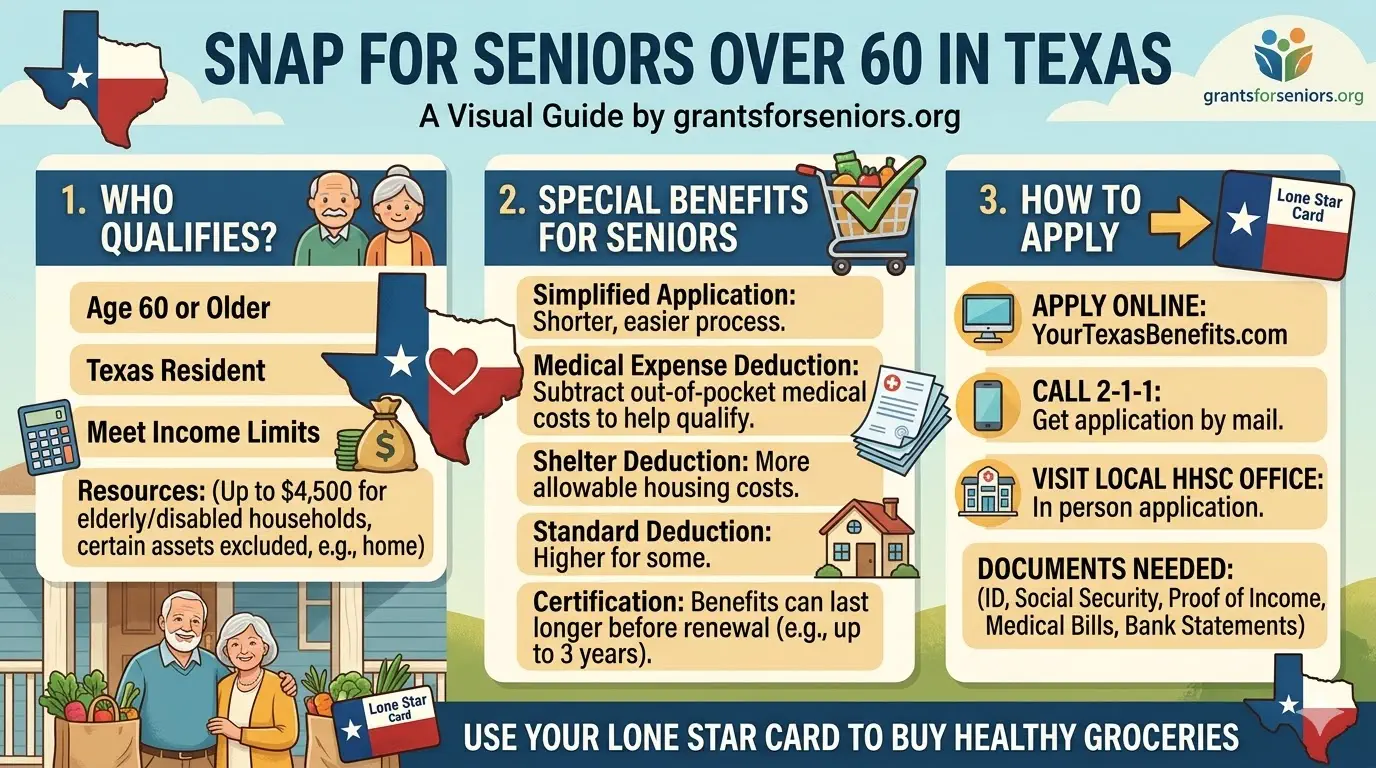
You are considered elderly for Texas SNAP if you are age 60 or older. If your household has a member who is 60+ or has a qualifying disability, Texas gives special treatment: the usual gross-income test does not apply, unreimbursed medical costs over $35 a month can help, and the excess shelter deduction is not capped for that household under the state handbook’s senior SNAP rules.
Texas also uses a state option that lets many households qualify with a $5,000 countable-resource limit and a 165% of poverty gross-income figure for broad-based categorical eligibility, according to the USDA Texas summary. That resource test looks at countable resources, not everything you own. The Texas handbook excludes many tax-favored retirement accounts, the full cash value of prepaid burial plans, and one burial plot per household member.
| Household size | Net monthly income limit | Texas 165% figure used in some Texas cases | Maximum monthly SNAP amount |
|---|---|---|---|
| 1 | $1,305 | $2,152 | $298 |
| 2 | $1,763 | $2,909 | $546 |
| 3 | $2,221 | $3,665 | $785 |
| 4 | $2,680 | $4,421 | $994 |
| Each additional person | +$459 | +$757 | +$218 |
Important note: the 165% column above still matters in Texas, but many older-adult households are judged under the net income rules after deductions because the usual gross-income test does not apply to households with a person age 60+ or with a qualifying disability under the Texas senior SNAP rules.
| Rule | What it means for Texas seniors | Why it matters |
|---|---|---|
| Gross-income test | The usual gross-income test does not apply if the household has someone age 60+ or with a qualifying disability. | Some seniors get denied too early because they stop at gross income. |
| Medical deduction | Unreimbursed medical costs over $35 a month can count. | Drug, premium, and other medical bills can raise benefits or make a case eligible. |
| Shelter deduction | Texas does not cap the excess shelter deduction for a household with an older or disabled member. | High housing and utility costs matter more for seniors than many websites explain. |
| Standard deduction | For FY 2026, it is $209 for 1 to 3 people, $223 for 4, $261 for 5, and $299 for 6 or more. | This deduction is automatic in the SNAP budget. |
| Countable resources | Texas uses a $5,000 countable-resource limit in its current state option summary. | Recent bank cash can matter, but many retirement and burial resources do not. |
Best assistance programs for seniors
The three most useful Texas SNAP paths for older adults are regular SNAP, TSAP, and SNAP-CAP. The program details below come from Texas Health and Human Services policy, Your Texas Benefits, and the Feeding Texas TSAP page.
Regular Texas SNAP for senior households
- What it is: the main Texas food-benefit program for households that need help paying for groceries through a benefits card account linked to SNAP.
- Who can get it: seniors who live in Texas and meet the state’s SNAP rules on household composition, income, resources, and immigration or citizenship status. If the household has a person age 60+ or with a qualifying disability, Texas gives the household special treatment under the senior and disability SNAP rules.
- How it helps: it can lower the cost of groceries each month, and the budget can improve when the household reports shelter costs, utility costs, and unreimbursed medical expenses over $35 a month.
- How to apply: apply through Your Texas Benefits, call 2-1-1 or 1-877-541-7905, or submit a paper application through the state process described in the Texas Works Handbook.
- What to gather: proof of income, recent housing and utility bills, and proof of out-of-pocket medical costs if you want the medical deduction. The Feeding Texas guide also recommends having pension or retirement letters, pharmacy statements, and bank statements ready.
Texas Simplified Application Project (TSAP)
- What it is: a simplified SNAP path Texas uses for certain older adults and people with disabilities. Texas says TSAP gives a 36-month certification period and no interview at recertification.
- Who can get it: households where all members are age 60 or older, receive disability payments, or both, nobody has earned income, and no one receives SNAP-CAP, under the state TSAP policy.
- How it helps: less paperwork, fewer renewal problems, and a simpler fit for many retired couples or single seniors on fixed income.
- How to apply: use Your Texas Benefits, ask a local Feeding Texas food bank for TSAP help, or call 2-1-1. Texas also says SNAP applicants are screened for TSAP as part of the normal process in the handbook.
- What to gather: retirement or disability income proof, bank statements, rent or mortgage and utility bills, and medical bills or pharmacy printouts, as listed by Feeding Texas.
SNAP-CAP for some SSI recipients
- What it is: a simplified Texas SNAP path for certain people who receive SSI. Texas says SNAP-CAP uses a mailed application, a 36-month certification period, and no face-to-face or phone interview.
- Who can get it: Texas says the person must receive SSI, be age 50 or older, live in Texas, not live in a disqualifying institution, and not already receive regular SNAP or TSAP under the SNAP-CAP rules.
- How it helps: very simple paperwork for the right SSI recipient, especially someone living alone.
- How to apply: many people are mailed a SNAP-CAP application automatically through the SSI data match described in the state handbook. If you think SNAP-CAP fits, call 2-1-1 and ask how to compare it with regular SNAP.
- What to gather: SSI information, address and shelter cost information, and any current SNAP notice if you already receive regular SNAP. Texas also says some people may prefer regular SNAP because it can produce a higher allotment in the SNAP-CAP opt-out rules.
How to apply without wasting time
These steps are built from the state application site, the Texas Works Handbook, and the Feeding Texas document checklist.
- File first, perfect later: Texas says a SNAP application can start with your name, address, and signature, so do not wait for every paper before filing.
- Use one place for everything: if you can, use Your Texas Benefits so you can apply, upload proof, and watch for notices in one account.
- Build your deduction packet before the interview: gather monthly shelter costs, utility bills, and every out-of-pocket medical bill you pay yourself.
- Do not skip medical proof: Texas says it should verify as much as possible through data matching, but medical expenses still require verification if you want the medical deduction in the handbook’s verification rules.
- Ask which program fits: if everyone is older or disabled and no one has wages, ask about TSAP. If you receive SSI and are 50+, ask about SNAP-CAP too.
- Name a helper early: if a parent misses calls or cannot manage the website, use an authorized representative or another responsible household member.
- Watch for follow-up: Texas may send a request for information or an interview notice even when you apply online, so check your account, voicemail, mail, and email every few days.
- Use phone help if the website is hard: call 2-1-1 or 1-877-541-7905 and choose Option 2 for state benefits questions.
Application checklist
Use this short checklist with the Feeding Texas TSAP guide and the Texas handbook.
- [ ] Your name, address, and signature so the application can be filed right away
- [ ] Social Security numbers and identity information for applicants
- [ ] Income proof, such as Social Security, pension, retirement, SSI, or disability award letters
- [ ] Recent bank statements if cash resources may matter in your case
- [ ] Rent, mortgage, property insurance, or other housing-cost proof
- [ ] Utility bills
- [ ] Pharmacy statements, medical bills, premium notices, and other out-of-pocket medical proof
- [ ] A helper’s information if you want an authorized representative
Reality checks
- Medical proof changes cases: under the Texas medical-deduction rules, unreimbursed medical costs can help a senior household, but Texas still requires proof if you want that deduction.
- TSAP is simpler, not automatic for every older Texan: if anyone in the household has earned income, the household does not fit the TSAP eligibility rules.
- SSI does not always mean SNAP-CAP is best: Texas says some SNAP-CAP recipients may do better under regular SNAP, especially when shelter or medical costs are high.
- Food rules are changing soon: as of 21 March 2026, Texas still follows standard SNAP purchase rules, but the USDA-approved Texas food restriction waiver is set to take effect on 1 April 2026 and will exclude sweetened drinks and candy.
Common mistakes to avoid
These are the problems that most often waste time or lower a senior’s benefit.
- Waiting to apply until every document is perfect: Texas lets you file first with basic information in the application rules.
- Leaving medical costs off the form: many seniors list only income and forget pharmacy bills, premiums, or other out-of-pocket medical costs that can count under the medical-deduction rules.
- Using TSAP when someone still works part-time: even a small amount of earned income can knock a household out of TSAP eligibility.
- Missing a phone interview or information request: if you use a spam blocker or do not check voicemail, the case can stall.
- Not naming a helper for a parent who cannot manage the case: Texas allows an authorized representative, and that can prevent missed deadlines.
- Example: a daughter uploads only the first page of a bank statement and no medical receipts. The state may still process the case, but the parent can lose weeks of time or miss a bigger deduction because the proof was incomplete.
Best options by need
Match the problem to the fastest realistic path.
- No food this week: call 2-1-1 for same-day pantries or senior meals, then file on Your Texas Benefits the same day.
- Retired couple, no wages: ask about TSAP.
- SSI recipient age 50+: compare SNAP-CAP with regular SNAP.
- High prescription or medical bills: use regular SNAP or TSAP, but make sure the bills are verified under the Texas medical-deduction rules.
- Adult child helping a parent: use an authorized representative and manage the case through Your Texas Benefits.
- Food lost in a power outage or flood: watch the USDA Texas disaster page and ask 2-1-1 Texas about replacement benefits.
- Homebound or rural senior: use online, mail, fax, or phone options listed in the Texas application rules, and ask your local Area Agency on Aging for help.
If your application gets denied
Use the denial notice and the official Texas appeal information from Form H0599 and the state’s fair hearing procedures.
- Read the reason first: look for whether the notice says missing information, income too high, resources too high, or another technical reason.
- Call and ask direct questions: use 2-1-1 or 1-877-541-7905, choose Option 2, and ask: “Was I denied because proof was missing, or because the state decided I was not eligible?”
- Request a fair hearing if the notice looks wrong: Texas says the fastest way to ask for a hearing is by calling 2-1-1 or 1-877-541-7905. You can also mail a letter or go to an HHSC benefits office, using the instructions in Form H0599.
- Ask about continued benefits if your notice is cutting or stopping an active case: the Texas fair hearing guide warns that you may have to repay those benefits if you lose the appeal.
- Use the backup path too: if the problem is just a missing bill or bank statement, it can be faster to upload the proof and reapply than to wait for a long dispute.
If SNAP is delayed, try these backup food options
Local help changes often, so Texas seniors usually do best with live directories instead of old blog lists.
- Call 2-1-1 Texas: ask for food pantries, senior congregate meals, churches, and rent or utility help in your ZIP code.
- Contact your Area Agency on Aging or local aging and disability office through the Texas HHS services finder: these offices can help older adults find benefits counseling and local nutrition support.
- Use a Feeding Texas food bank: many Texas food banks help with SNAP or TSAP applications and also offer emergency groceries.
- Ask whether your area has a Senior Box program: some Texas food banks run the USDA Commodity Supplemental Food Program for seniors; the East Texas Food Bank Senior Box page is one example of how this can work locally.
Local resources in Texas
- 2-1-1 Texas: use 2-1-1 Texas or call 1-877-541-7905 for county-by-county food help, churches, community action agencies, and benefits support.
- Area Agencies on Aging: the Texas HHS AAA directory can point older adults to benefits counseling and local senior services.
- Aging and Disability Resource Centers: use the Texas HHS services finder if you need help with aging or disability services near you.
- Food-bank application help: Feeding Texas can connect seniors with a local food bank for SNAP or TSAP help.
- Disaster updates: the USDA Texas disaster page is the best place to check for replacement benefits or hot-food waivers after a storm.
Diverse communities
- Seniors with Disabilities: Texas counts many SSI, Social Security disability, Railroad Retirement disability, and certain Veterans Affairs disability situations under the SNAP disability rules. These households can get the medical deduction, the uncapped shelter deduction, and in some cases TSAP. Texas also says it must provide interpreter, translation, and effective communication help in the interview procedures.
- Veteran Seniors: under the Texas handbook’s disability definition, some veterans with a 100% service-connected disability, regular aid and attendance, or permanent housebound status may qualify for the senior and disability SNAP rules. Some surviving spouses can also qualify under that same rule.
- Tribal-Specific Resources: the Texas handbook says Indian Tribal households in Polk County may have coordination between SNAP and the Food Distribution Program on Indian Reservations (FDPIR) so people do not receive duplicate benefits.
- Rural Seniors with Limited Access: Texas allows SNAP applications online, by mail, by fax, in the local office, and by phone request in the application rules. If broadband is weak, use 2-1-1, a local AAA, or an authorized representative.
Other options
- If the benefit amount seems too low: ask HHSC to confirm that every shelter, utility, and medical cost was counted under the Texas budgeting rules.
- If you have retirement savings: do not assume that an IRA, 401(k), 403(b), 457(b), or federal Thrift Savings Plan automatically blocks SNAP. The Texas resource rules exclude many tax-favored retirement accounts.
- If you prepaid funeral costs: the Texas handbook excludes the full cash value of prepaid burial insurance, funeral plans, and funeral agreements.
- If you are close to age 60: recheck eligibility after your 60th birthday, because Texas defines “elderly” as age 60 or older in the SNAP age rule.
Frequently asked questions
Can I get Texas SNAP if I receive Social Security retirement or a pension?
Yes, maybe. Social Security retirement and pension income usually count as income, but older adults still get special SNAP rules in Texas. The usual gross-income test does not apply if your household has someone age 60+ or with a qualifying disability under the Texas senior SNAP rules. That means your net income after deductions may matter more, especially if you have high housing or medical costs. The current federal income tables are on the USDA FY 2026 SNAP page.
Does Texas have a special SNAP program just for seniors?
Yes. Texas has the Texas Simplified Application Project (TSAP) for households where all members are age 60 or older, receive disability payments, or both, and nobody has earned income. Texas says TSAP gives a 36-month certification period and no interview at recertification. If your household fits, TSAP is often the easiest path. If you want help applying, Feeding Texas lists local food-bank assistance.
What if my parent gets SSI?
A Texas senior who gets SSI may fit SNAP-CAP, which is a simplified SSI-linked SNAP path for people age 50 and older. But Texas also says a person on SNAP-CAP may choose regular SNAP because regular SNAP can pay more in some cases. If your parent has high rent, utility, or medical costs, ask HHSC to compare both options through 2-1-1 Option 2 or Your Texas Benefits.
Do medical expenses really make a difference?
Very often, yes. Texas allows a medical deduction when unreimbursed medical costs for the older or disabled household member exceed $35 a month under the medical-deduction rules. That can change both eligibility and the monthly amount. The problem is that medical expenses must be verified if you want the deduction, so uploading bills, pharmacy printouts, and premium notices matters.
Can my daughter, son, or caregiver handle the SNAP case for me?
Usually, yes. Texas lets a household name an authorized representative, and for SNAP another responsible household member may also be interviewed. This can help when a senior is homebound, misses phone calls, or is overwhelmed by paperwork. If you are helping a parent, set this up early and use Your Texas Benefits to upload documents and watch for notices.
Do I have to allow a home visit?
Not automatically. Texas says in the home-visit rules that no one should be denied for refusing to agree to a home visit unless there is no other sufficient and reliable verification available. If a worker asks for a visit, ask what information is missing and whether you can prove it another way first.
Can Texas SNAP buy hot meals, candy, or sweetened drinks?
As of 21 March 2026, normal SNAP rules still apply in Texas, which means hot prepared foods usually are not allowed unless a disaster waiver is active. The USDA Texas disaster page said there were no active disaster response efforts on that date. For candy and sweetened drinks, the big change is still ahead: the USDA-approved Texas food restriction waiver is scheduled to take effect on 1 April 2026.
What if my parent lives with me?
If you buy and prepare food together, Texas may treat you as one SNAP household. If you buy and prepare food separately, you may be able to apply separately. There is also a narrow separate-household rule tied to the 165% income figure for some older adults with disabilities who live with others, so this is a good place to ask case-specific questions through 2-1-1 Option 2 or an application assister.
What should I do if Texas is taking too long?
First, check Your Texas Benefits for missing notices or proof requests. Then call 2-1-1 or 1-877-541-7905 and ask whether the case is waiting on an interview, missing proof, or an eligibility decision. If the state sends a denial or cut that looks wrong, use the instructions in Form H0599 and the Texas fair hearing guide to appeal.
Resumen en español
Si usted tiene 60 años o más y vive en Texas, puede pedir ayuda para comprar comida por medio de Your Texas Benefits. En Texas, los hogares con una persona mayor o con discapacidad tienen reglas especiales en SNAP bajo el Texas Works Handbook. Eso significa que muchas personas mayores no usan la prueba normal de ingreso bruto y pueden recibir una deducción por gastos médicos de su propio bolsillo de más de $35 al mes. También puede ayudar mucho reportar renta, hipoteca, servicios públicos y otros gastos de vivienda.
Si todas las personas del hogar tienen 60 años o más, o reciben pagos por discapacidad, y nadie tiene ingresos por trabajo, pregunte por TSAP. TSAP puede ser más fácil porque Texas usa un período de certificación de 36 meses y no pide entrevista en la recertificación. Si recibe SSI, pregunte también por SNAP-CAP, aunque en algunos casos SNAP regular puede pagar más.
Si necesita ayuda hoy mismo, llame al 2-1-1 o al 1-877-541-7905 y pida ayuda con beneficios estatales, despensas, comidas para adultos mayores y recursos locales. Si le niegan el caso y usted cree que la decisión está mal, puede pedir una audiencia usando las instrucciones de Form H0599. Y si una tormenta dañó la comida comprada con SNAP, revise la página oficial de desastres de USDA para Texas para ver si hay beneficios de reemplazo o permisos temporales para comprar comida caliente.
About This Guide
This guide uses official federal and state sources, along with other high-trust nonprofit and community resources mentioned in the article.
Editorial note: This guide is produced based on our Editorial Standards using official and other high-trust sources, regularly updated and monitored, but not affiliated with any government agency and not a substitute for official agency guidance. Individual eligibility outcomes cannot be guaranteed.
Verification: Last verified 21 March 2026, next review 21 July 2026.
Corrections: Please note that despite our careful verification process, errors may still occur. Email info@grantsforseniors.org with corrections and we respond within 72 hours.
Disclaimer: This article is for informational purposes only. It is not legal, financial, disability-rights, immigration, veterans-benefit, or government-agency advice. SNAP rules, program policies, waiver dates, food-purchase rules, and local resource availability can change. Always confirm current details directly with Your Texas Benefits, 2-1-1 Texas, or the other official program listed before you act.
About the Authors