

Tax Help for Seniors in 2026: Free Filing Help, Credits, Property Tax Relief, and Ways to Pay Less
Written & Reviewed by


Last updated: 23 March 2026
Bottom line: Tax help for seniors is not one single program. Most older adults need help in one of four ways: free filing help, figuring out whether they need to file, lowering taxes legally with credits or deductions, or applying for separate property-tax relief.
Bottom line: Federal income tax, state income tax, and property-tax relief are often handled by different offices. Many seniors overpay because they miss free filing help, overlook deductions, or never file a separate local property-tax application.
Emergency help now
- If the 15 April 2026 federal deadline is very close and you are not ready: file an IRS extension now and pay what you can using IRS payment options. An extension gives you more time to file, not more time to pay.
- If you got an IRS notice: open it today, find the CP or LTR number, use the IRS notice lookup page, and respond by the deadline. If you need help, call the number on the notice or 1-800-829-1040.
- If a property-tax deadline or delinquency notice is approaching: call your county tax office, assessor, or treasurer today using your local government’s official site, and ask about senior exemptions, rebates, freezes, deferrals, hardship plans, or appeal deadlines. If you do not know where to start, use the Eldercare Locator or call 1-800-677-1116.
Quick help:
- I need free filing help: start with the IRS VITA/TCE page, the VITA/TCE locator, or AARP Foundation Tax-Aide at AARP.org.
- I am not sure I even need to file: use the IRS Interactive Tax Assistant and compare your income to the filing thresholds below.
- I think I am overpaying: check the higher standard deduction, the enhanced senior deduction if current and verified, and the Credit for the Elderly or Disabled.
- I need property-tax relief: start with your state tax agency and your local property-tax office. Federal filing does not usually apply for this for you.
- I only get Social Security: you may not need to file a federal return, but check first if tax was withheld, if you have state filing duties, or if you need to claim another relief program.
What tax help for seniors actually looks like
Start here: first figure out what kind of tax help you need. Most seniors fall into one of these four groups:
- Free filing help: you want a trusted person or free software to help prepare your return.
- Do I need to file? you want to know whether your income is high enough to require a return.
- Ways to pay less: you want to know whether you qualify for deductions, credits, exclusions, or better withholding.
- Property-tax relief: you need a separate state, county, or city program to lower housing costs.
Most important rule: federal income tax, state income tax, and property-tax relief are often different systems handled by different offices. Many seniors waste time because they treat them like one program.
Plain-English definitions: a deduction lowers the income you are taxed on. A credit lowers your tax bill directly. A property-tax exemption, rebate, freeze, or deferral is usually a separate local or state relief program.
Quick facts
- Best immediate takeaway: many seniors can save money just by filing correctly and not missing separate property-tax deadlines.
- Major rule: if you are 65 or older, you may qualify for a higher standard deduction and, if current IRS guidance still applies, an enhanced senior deduction.
- Realistic obstacle: volunteer tax sites are excellent, but they do not prepare every kind of return, and local property-tax programs often need separate forms and proof.
- Useful fact: the IRS announced $53 million in 2026 grants for VITA and TCE providers, and AARP Foundation Tax-Aide reported helping more than 1.7 million taxpayers last season.
- Best next step: gather your 2025 tax forms now, then choose the right path below instead of waiting until April.
Do seniors have to file taxes?
Check this before you do anything else. Many older adults assume they always have to file, while others assume they never do. Both mistakes can cost money.
If the only income you got in 2025 was Social Security, the IRS says your benefits generally are not taxable and you probably do not need to file a federal return. But once you add a pension, IRA withdrawal, wages, interest, dividends, or other income, the answer can change. See IRS Publication 554 and the IRS Interactive Tax Assistant.
For many older adults, these are the basic 2025 federal filing thresholds used in the 2026 filing season:
| 2025 filing status | File a federal return if gross income is at least |
|---|---|
| Single, age 65 or older | $17,750 |
| Head of household, age 65 or older | $25,625 |
| Married filing jointly, one spouse age 65 or older | $33,100 |
| Married filing jointly, both spouses age 65 or older | $34,700 |
| Qualifying surviving spouse, age 65 or older | $33,100 |
| Married filing separately, any age | $5 |
Important: these filing thresholds are not the same as the rules for when Social Security becomes taxable. They also do not decide whether you qualify for a state property-tax rebate or senior exemption.
Who qualifies for tax help
Different kinds of tax help use different rules.
- Free filing help: VITA is generally for people who make $69,000 or less, people with disabilities, and taxpayers who need language support. TCE is focused on people age 60 or older. AARP Foundation Tax-Aide focuses on older adults and low- to moderate-income taxpayers, but site rules can differ.
- Deductions and credits: rules can depend on age, income, filing status, disability status, and whether you are married filing jointly.
- Property-tax relief: states and local offices often ask about age, disability status, income, home ownership, occupancy, or renter status.
- Helping a parent: you can gather records and schedule appointments, but if you need to speak to the IRS directly you may need authorization such as Form 8821 or Form 2848.
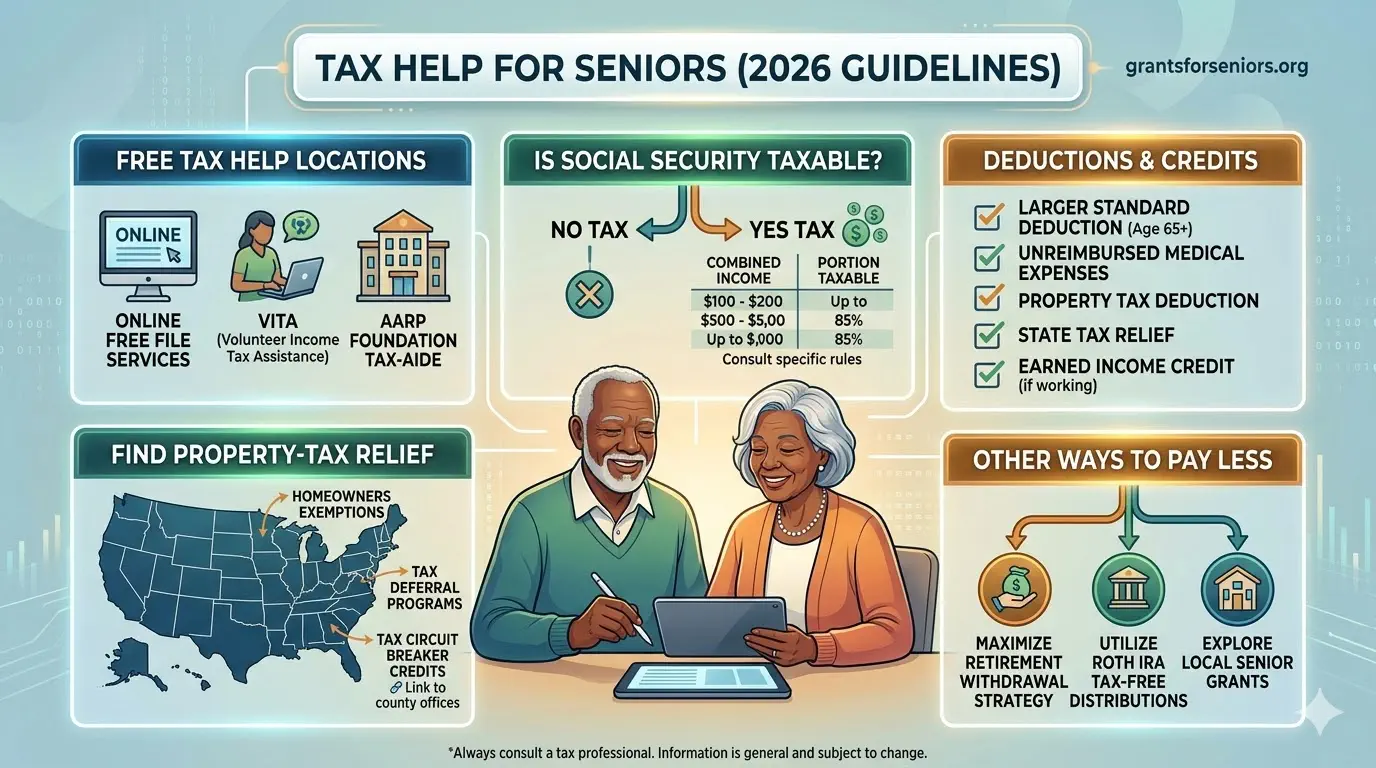
Best tax help options for seniors
Volunteer Income Tax Assistance (VITA)
- What it is: free tax return preparation by IRS-certified volunteers.
- Who can get it: generally people who make $69,000 or less, people with disabilities, and taxpayers who need language help.
- How it helps: good for many seniors with Social Security, a pension, part-time wages, and a basic return.
- How to apply: use the VITA/TCE locator or call 1-800-906-9887.
- What to gather: photo ID, Social Security cards or ITIN papers, last year’s return, Forms W-2 and 1099, SSA-1099, 1099-R, and bank information for direct deposit.
Tax Counseling for the Elderly (TCE)
- What it is: a free IRS-supported filing program for people age 60 or older.
- Who can get it: older adults, especially those with pensions, annuities, and retirement-income questions.
- How it helps: often a better fit than general help when the main issue is retirement income rather than wages.
- How to apply: use the IRS locator or call 1-800-906-9887.
- What to gather: the same papers used for VITA, especially every 1099-R and SSA-1099.
AARP Foundation Tax-Aide
- What it is: free tax preparation help through local sites, drop-off help, and some remote options.
- Who can get it: AARP says it focuses on people over 50 and low- to moderate-income taxpayers, though site rules can differ. You do not need to be an AARP member.
- How it helps: often the easiest backup when IRS volunteer appointments are full.
- How to apply: use the Tax-Aide locator or call 1-888-227-7669.
- What to gather: the same forms you would bring to VITA, plus any IRS or state notice you received.
IRS Free File
- What it is: free online filing through the IRS and partner software providers.
- Who can get it: taxpayers under the current IRS Free File AGI limit for the filing season.
- How it helps: useful if your return is simple and you are comfortable using a computer.
- How to apply: start from the official IRS Free File page, not from a search ad or software homepage.
- What to gather: prior-year AGI, all 2025 tax forms, bank details, and email access.
Deductions and credits older adults may miss
Start with the biggest ones first: the standard deduction, the extra age-based standard deduction, the enhanced senior deduction if still current and verified, and the Credit for the Elderly or Disabled.
| Tax break | What it does | Main rule | Why it matters |
|---|---|---|---|
| Standard deduction | Lowers taxable income | Available to most taxpayers who do not itemize | Main tax break many seniors use |
| Extra age-based standard deduction | Adds more deduction if age 65+ | Amount depends on filing status | Easy to miss if the age box is wrong |
| Enhanced senior deduction | Additional deduction under current law if verified | Rules depend on age, filing status, income, and valid SSN | Can help some seniors even if they itemize |
| Credit for the Elderly or Disabled | Lowers tax bill directly | Income limits are very low | Easy to miss, but many seniors do not actually qualify |
- What it is: these are the federal tax breaks many older adults ask about first.
- Who can get it: depends on age, income, filing status, disability status, and current IRS rules.
- How it helps: deductions lower taxable income; credits lower the bill directly.
- How to apply: claim the standard deduction and age-based add-on through the federal return, and figure the Credit for the Elderly or Disabled on Schedule R.
- What to gather: all income records, prior-year return, and any disability proof if applicable.
Reality check: the Credit for the Elderly or Disabled is well known but the income limits are very low, so many retirees do not qualify. That is why free filing help matters — a volunteer or preparer can tell you quickly whether it is worth claiming.
Social Security, pensions, IRA withdrawals, and withholding
- What it is: help with the most common reason older adults get a surprise tax bill.
- Who can get it: anyone with SSA-1099, 1099-R, interest, dividends, wages, or retirement withdrawals.
- How it helps: once one-half of your Social Security benefits plus other income and tax-exempt interest crosses the federal thresholds, part of your benefits may become taxable.
- How to apply: use the worksheet in the tax instructions or ask VITA, TCE, or Tax-Aide to review it.
- What to gather: SSA-1099, 1099-R, 1099-INT, 1099-DIV, and records of any withholding or estimated payments.
Example: a retiree who gets only Social Security may not owe federal tax. A retiree who gets Social Security plus a pension may suddenly have part of those benefits taxed. That is why both the SSA-1099 and the 1099-R matter.
Withholding warning: if too little tax was withheld in 2025, fix it now for 2026. If you want tax withheld from Social Security, the IRS says to use Form W-4V.
Property-tax relief for seniors
- What it is: separate state and local programs that may lower property taxes through exemptions, rebates, freezes, or deferrals.
- Who can get it: rules vary sharply by state, county, city, age, income, disability status, and whether you own or rent your main home.
- How it helps: some programs lower the bill up front, some send money back later, some freeze future increases, and some let you delay payment.
- How to apply: start with your state tax agency and local property-tax office. Do not assume your federal return applies for you.
- What to gather: property-tax bill or rent certificate, proof of ownership or occupancy, ID, income records, and any age or disability proof the program asks for.
Common property-tax relief types:
- Exemption: lowers taxable value or part of the bill.
- Rebate or circuit breaker: sends money back after payment, often based on income.
- Freeze: limits future increases if you qualify.
- Deferral: lets you delay payment. This is not free money. It may create a lien or add interest.
Important: this tax-help hub only gives the overview. The exact savings and deadlines depend on your state and local office, so seniors should also use a separate state-by-state property-tax relief guide.
| State example | Program | Why it matters | Where to start |
|---|---|---|---|
| Pennsylvania | Property Tax/Rent Rebate | Shows that renters may qualify too | Pennsylvania PTRR page |
| New York | Enhanced STAR | Shows how school-tax relief can work separately | New York STAR page |
| New Jersey | ANCHOR / Senior Freeze / Stay NJ | Shows that one state may have several overlapping senior programs | New Jersey ANCHOR page |
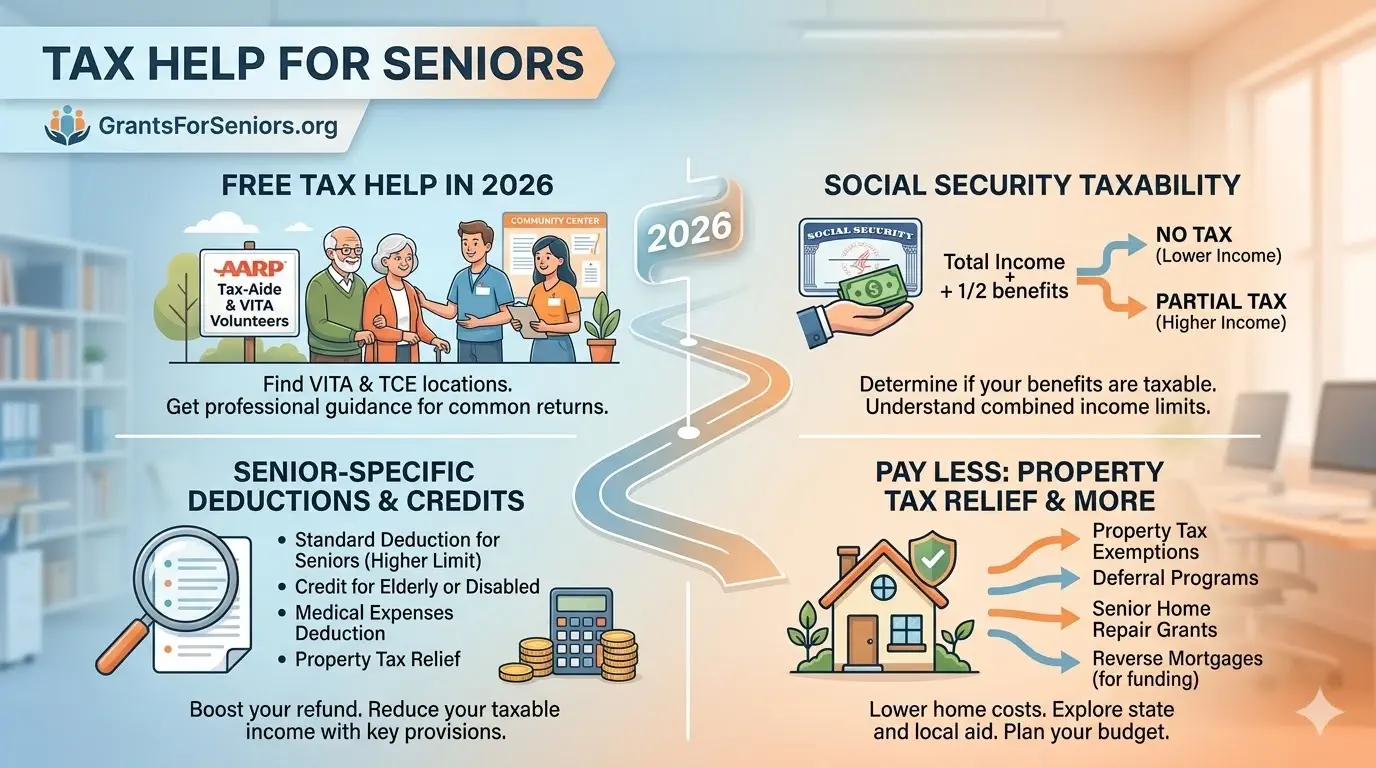
How to get tax help without wasting time
- Sort the problem first: federal return, state return, property-tax relief, or IRS debt. This saves the most time.
- Gather every 2025 tax form before booking help: especially SSA-1099, 1099-R, W-2, 1099-INT, 1099-DIV, and property-tax papers.
- Replace missing forms early: use my Social Security for SSA-1099 and contact pension payers or banks for missing 1099 forms.
- Pick the right help level: use VITA, TCE, or Tax-Aide if you want a person. Use IRS Free File if your return is simple and you want to file online.
- Ask whether your return is in scope: some volunteer sites do not prepare complex capital gains, rental income, or business losses.
- Keep copies of everything: save your return, worksheets, notices, property-tax application, and filing confirmation.
Application checklist
- ☐ Photo ID for you and your spouse if filing jointly
- ☐ Social Security cards or ITIN papers for everyone on the return
- ☐ Last year’s federal and state returns, if available
- ☐ All 2025 income forms: W-2, 1099-R, SSA-1099, 1099-INT, 1099-DIV, 1099-G, and others
- ☐ Form 1095-A if you had Marketplace health insurance
- ☐ Bank routing and account numbers for direct deposit
- ☐ Property-tax bill, rent certificate, or rebate notice for local relief programs
- ☐ Any IRS, state, or property-tax notice you received
- ☐ Proof of age, disability, or veteran status if a property-tax program asks for it
Reality checks
- Free help is excellent, but not unlimited: volunteer sites do not prepare every kind of return.
- Missing forms cause real delays: seniors often wait too long to replace SSA-1099 or 1099-R forms.
- Property-tax relief is easy to miss: a federal refund does not mean your county already knows you qualify for local relief.
- Not every senior tax break helps every senior: some credits have very low income caps, and some property-tax programs are only for homeowners.
Common mistakes to avoid
- Assuming “I only get Social Security” means “I never need to file.” Other income, withholding, or state rules can change the answer.
- Using old numbers from older articles. Free File limits, deduction amounts, and local property-tax deadlines can change.
- Missing the new senior deduction rules. The enhanced deduction is separate from the usual age-based standard deduction.
- Ignoring withholding after retirement. A pension or IRA withdrawal can trigger tax even if your Social Security was not taxable before.
- Thinking Form 1040-SR creates savings by itself. It is just a senior-friendly form; the savings come from the tax rules and correct filing.
- Missing separate property-tax deadlines. A missed state or county deadline can cost a full year of relief.
Best options by need
- I need free filing help: start with VITA, TCE, or AARP Foundation Tax-Aide.
- I am not sure if I need to file: compare your income with the filing thresholds and use the IRS Interactive Tax Assistant.
- I think I am overpaying: review deductions, credits, withholding, and whether part of your Social Security is becoming taxable because of other income.
- I need property-tax relief: check your state tax agency and your local property-tax office, not just your federal return.
- I got an IRS notice: use the IRS notice page, respond by the deadline, and do not wait for a general appointment if the due date is close.
- I am helping my parent: gather records first, then ask what authorization is needed before speaking to the IRS directly.
If your filing, claim, or application gets delayed or rejected
- Ask why: find out whether the problem is missing records, identity mismatch, scope limits, or a deadline issue.
- Replace missing tax forms right away: do not guess the numbers if official forms are missing.
- For IRS notice issues: call the number on the notice, ask about payment plans, or use the Taxpayer Advocate Service if the issue is serious.
- For property-tax denial or delay: ask whether there is an appeal, review, or late-file option, and ask exactly what proof was missing.
- For free filing sites that cannot help: try another volunteer site, AARP Tax-Aide, IRS Free File, or a qualified paid professional if the return is too complex.
What to try if the first path does not work
- If VITA is full: try TCE or AARP Foundation Tax-Aide.
- If free help says your return is too complex: look for an enrolled agent or certified public accountant.
- If you missed a federal filing deadline: file as soon as possible and review payment-plan options.
- If your local property-tax office says no: ask whether there is a different program for renters, disabled seniors, veterans, or low-income homeowners.
Local resources
- Area Agencies on Aging: use the Eldercare Locator or call 1-800-677-1116 to find local aging help.
- Libraries and senior centers: many host AARP Tax-Aide or other free filing appointments.
- Legal aid and tax clinics: these can help if the problem is a notice, dispute, or collection issue rather than a simple filing question.
- State tax agencies and local property-tax offices: these are often the only places that can confirm state tax exclusions, rebates, exemptions, or freezes.
Diverse communities
- Seniors with Disabilities: many volunteer sites can help taxpayers with disabilities, and some property-tax programs also use disability-based rules. The IRS allows accessible notices through Form 9000.
- Veteran Seniors: some states and counties have special property-tax relief for disabled veterans, and eligible military retirees and survivors may use MilTax for free filing help.
- Immigrant and Refugee Seniors: VITA serves many limited-English taxpayers, and some sites can help with Form W-7 for an ITIN. The IRS says it offers help in more than 350 languages.
- Rural Seniors with Limited Access: use the Eldercare Locator by phone and ask AARP Tax-Aide about remote or drop-off options if transportation is hard.
Other options
If free help does not fit your case, paid help may be worth it. This is especially true if you sold a home, have rental or business income, have an inherited retirement account, need multiple late returns, or are dealing with estate papers. In those cases, look for an enrolled agent, CPA, or tax attorney. For deed issues, property-tax appeals, or estate-related tax problems, an elder-law attorney may be more useful than a return preparer.
Frequently asked questions
Where can seniors get free tax help near them?
The fastest places to start are the IRS VITA/TCE locator and AARP Foundation Tax-Aide. Many sites operate in libraries, senior centers, schools, and community buildings during tax season.
Do seniors get a bigger standard deduction?
Yes, many taxpayers age 65 or older qualify for an extra age-based standard deduction. The exact amount depends on filing status. You still need to make sure the age boxes and return details are correct so the software or preparer applies it properly.
Do seniors have to file taxes if they only get Social Security?
Often, no. If Social Security was your only income, you generally may not need to file a federal return. But check if tax was withheld, if you have state filing duties, or if you need to claim another relief program.
Is Social Security taxable?
It can be. Once one-half of your Social Security benefits plus other income and tax-exempt interest goes over the federal thresholds, part of your benefits may become taxable.
What tax credits do seniors qualify for?
The most discussed federal items are the higher standard deduction, the enhanced senior deduction if still current and verified, and the Credit for the Elderly or Disabled. State tax exclusions and property-tax relief programs may also help.
How can seniors lower property taxes?
Check whether your state or county offers an exemption, rebate, circuit-breaker credit, freeze, or deferral. These programs are often separate from your federal income-tax return.
What if I missed a filing deadline?
File as soon as you can. If you know before the deadline that you need more time, use an IRS extension. If you already missed it, file anyway rather than waiting longer and letting penalties grow.
Can an adult child help a parent file taxes?
Yes. Adult children often gather papers, schedule appointments, and sit with parents during filing. But formal IRS access may require written authorization.
Resumen en español
La ayuda tributaria para adultos mayores no es un solo programa. Muchas personas mayores necesitan ayuda en una de cuatro formas: ayuda gratuita para presentar impuestos, saber si realmente tienen que presentar una declaración, bajar lo que pagan con deducciones o créditos, o solicitar alivio del impuesto a la propiedad.
Para ayuda gratuita con la declaración federal, empiece con la página oficial de VITA y TCE del IRS o con AARP Foundation Tax-Aide. Si solo recibe Seguro Social, es posible que no tenga que presentar una declaración federal, pero debe verificarlo. Si también recibe pensión, intereses bancarios o retiros de una cuenta IRA, parte de sus beneficios puede volverse tributable.
Para el impuesto a la propiedad, revise primero la oficina oficial de impuestos de su estado, condado o ciudad, porque las reglas cambian mucho. Si no sabe a dónde llamar, use el Eldercare Locator o llame al 1-800-677-1116 para encontrar ayuda local.
About This Guide
This guide uses official federal and state sources, along with other high-trust nonprofit and community resources mentioned in the article.
Editorial note: This guide is produced based on our Editorial Standards using official and other high-trust sources, regularly updated and monitored, but not affiliated with any government agency and not a substitute for official agency guidance. Individual eligibility outcomes cannot be guaranteed.
Verification: Last verified 23 March 2026, next review 23 July 2026.
Corrections: Please note that despite our careful verification process, errors may still occur. Email info@grantsforseniors.org with corrections and we respond within 72 hours.
Disclaimer: This article is informational only. It is not legal, tax, financial, disability-rights, immigration, veterans-benefit, or government-agency advice. Program rules, filing thresholds, deadlines, policies, and availability can change. Confirm current details directly with the official program or tax agency before you file, pay, appeal, or rely on any benefit or relief program.
About the Authors